

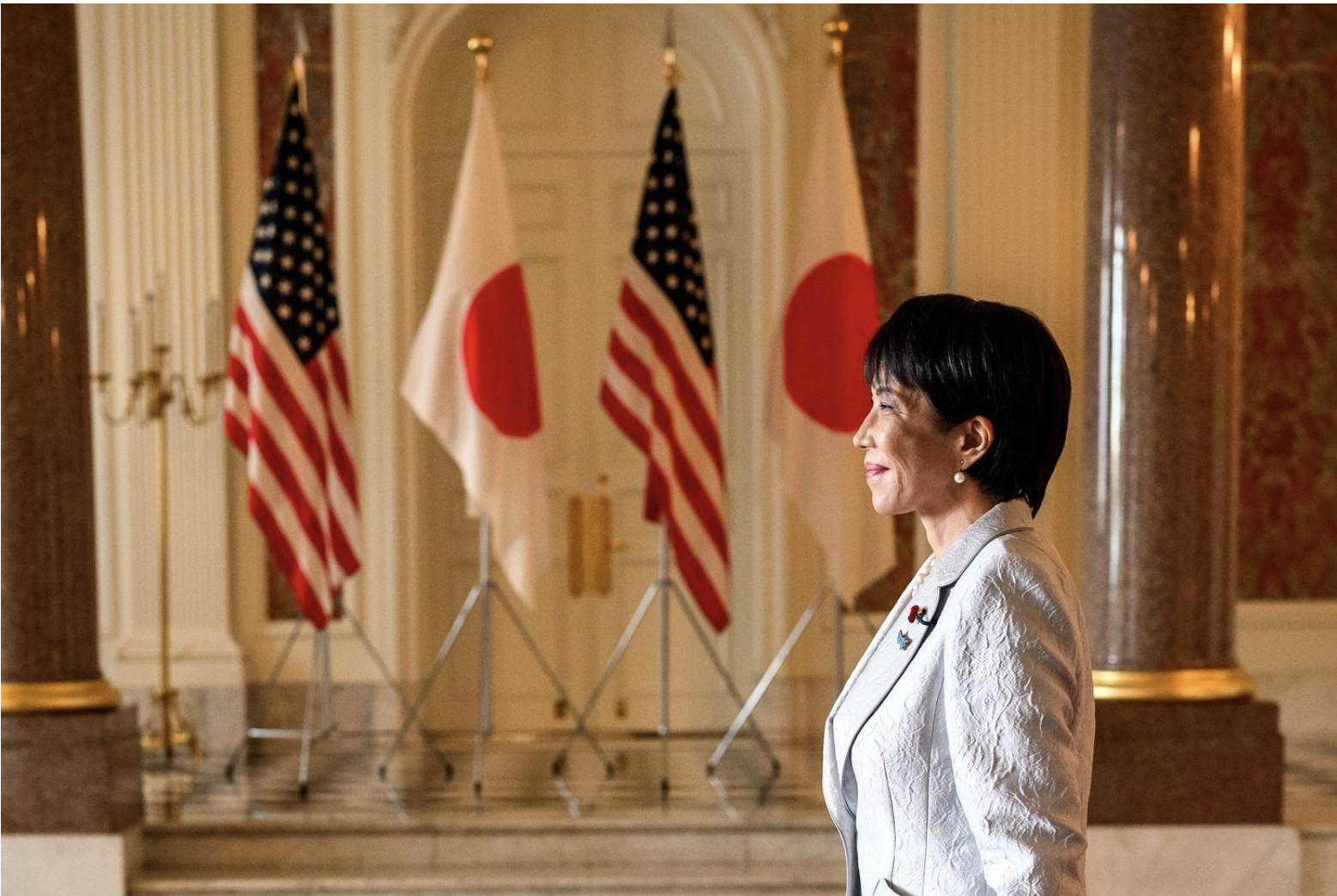
“Japan is back.” In 2013, former Prime Minister Shinzo Abe sent a clear message to the world that Japan would return as a great power on the global stage. Through what came to be known as the “Abe Doctrine,” he laid out his foreign policy blueprint to restore Japan’s economic clout lost during the “Lost Decades” and reinterpret Article 9 of the Constitution to expand the scope of the missions the Self-Defense Forces (SDF), Japan’s post-WWII military force, could carry out. However, much of that plan never fully materialized due to a lack of broad domestic political consensus, especially when it came to security reform.
Thirteen years later, that blueprint is finally coming into view. Prime Minister Sanae Takaichi’s landslide victory in the lower-house election earlier this February signals that Japan is ready to step up by modernizing its military and recalibrating its role as an anchor of regional stability alongside the United States. Strengthening defense capabilities and deterring China’s growing coercion were among the main issues Takaichi focused on during her campaign, and voters responded by handing her a historic mandate. Takaichi’s Liberal Democratic Party (LDP) won 316 seats out of 465, which far exceeds the threshold of an absolute majority. That wide margin gives her cabinet enough political capital to push defense reform further and faster to finally fulfill the plan Abe envisioned.
Security Environment
The Indo-Pacific has now emerged as the central arena of 21st-century great-power competition. The region produces more than half of global GDP, is home to over half of the world's population, and contains maritime chokepoints that keep the global economy running. Any power that dominates the region can strong-arm its way to global hegemony.
In this high-stakes environment, China’s military buildup and coercive activities are growing in both scale and sophistication. In 2025, the People’s Liberation Army (PLA) conducted record-breaking air and maritime activities around Taiwan, marking a sharp increase in average monthly PLA activities compared to 2024, when Taiwan President Lai Ching-te took office. The PLA conducted two large-scale exercises and carried out 163 operations in the South China Sea, including expanded live-fire drills. From Beijing’s perspective, subjugating Taiwan is not an end goal but a starting point—a strategic foothold for building its sphere of influence that stretches beyond the First Island Chain, and ultimately achieving regional hegemony. The U.S., Japan, and other regional partners therefore share a core interest in preventing any use of force to alter the status quo, ensuring that the region does not fall under a single power.
Takaichi has read this reality surrounding Tokyo through a clear-eyed lens of pragmatic realism and ambitious revisionism. As a long-standing security hawk, she understands that power politics is back and Japan will no longer be sitting on the sidelines. The question that Takaichi’s Japan has to grapple with is no longer whether Tokyo should step up, but how far and through what means.
Article 9
Revising Article 9 of Japan’s Constitution—the postwar pacifist clause that renounces war as a sovereign right and limits Japan’s military role to self-defense—sits at the center of Takaichi’s security agenda. Bounded by this provision, the Self-Defense Forces (SDF) have long been subject to significant legal and political constraints. Takaichi has been consistent about her intentions to revise the pacifist clause to formally recognize the SDF as a military institution that could operate beyond purely defensive purposes. For example, at a Lower House Budget Committee session in November 2025, she explicitly stated that China’s use of force on Taiwan poses a direct threat to Japan’s survival and Tokyo must be prepared to respond, including the option of mobilizing the SDF if necessary. Constitutional reform is a complex process that requires approval by the upper house and a national referendum, adding uncertainty to Takaichi’s plan. But given Takaichi’s public resolve and the growing share of the Japanese public viewing China as a primary security threat, it would be too early to rule out such a possibility.
Military Modernization and Economic Statecraft
The trajectory of Japan’s military spending also echoes the urgency of the situation, as it faces simultaneous military pressure from the growing strategic alignment of China, Russia, and North Korea. Japan is set to meet its target of spending 2% of its GDP on defense ahead of schedule, in the fourth year of its five-year target. For fiscal year 2026, the Japanese cabinet approved a record-breaking defense budget exceeding $58 billion, which increased by 9.4% compared to the previous year. On top of that, Tokyo is stockpiling munitions to avoid supply-chain vulnerabilities, investing in drones and long-range counterstrike capabilities, expanding missile defense architecture with hypersonic weapons, and fortifying its southwestern islands near Taiwan. Furthermore, Japan is also lifting restrictions on arms exports to strengthen its defense-industrial base and focusing on satellite reconnaissance to detect threats in space by monitoring and tracking adversarial satellite activities.
At the same time, the Takaichi cabinet is ramping up investment in cutting-edge technologies, particularly artificial intelligence and semiconductor capacity, to prepare Japan for an age of superintelligence that might arrive sooner than expected and to reduce the negative ramifications of global supply chain disruptions. In her campaign speeches, she repeatedly pointed out the need for “crisis management investment and growth,” tying economic security and technological advancement. Takaichi is now carrying out that promise through the Headquarters for Japan’s Growth Strategy, a Cabinet-level body that aligns public investment, foreign capital, and talent development. In other words, Japan’s military capability and industrial policy are moving in the same direction. Tokyo clearly recognizes that strategic competition in the Indo-Pacific will not be decided solely on the battlefield but also through supply chain resilience, technological innovation, and industrial capacity. Takaichi’s approach, therefore, is to treat defense modernization, economic security, and technological investment as a single package rather than separate policy areas.
Alliance Modernization
Tokyo stepping up its defense capabilities and contributing more to regional security could not have come at a better moment for Washington, as they directly align with the framework laid out in the Trump administration’s 2025 National Security Strategy and 2026 National Defense Strategy. Both documents emphasize the importance of burden-sharing and collective denial deterrence, which requires key allies like Japan to increase defense spending and invest more in their military capabilities. Recent agreements and initiatives are ushering the U.S.–Japan alliance into a new phase. From a relatively asymmetric structure, where Japan relied heavily on U.S. extended deterrence, it is shifting toward a more balanced and integrated alliance grounded in shared capabilities. For instance, the U.S.–Japan Technology Prosperity Deal and the United States–Japan Framework for Securing the Supply of Critical Minerals and Rare Earths are two milestones that clearly demonstrate the upgrade. Together, they have laid the groundwork for expanding cooperation in artificial intelligence, semiconductors, quantum technologies, and supply chain resilience, while also securing upstream mining of critical minerals and navigating the challenges of securing access to the rare earth supply, which China currently dominates both in mining and processing.
Risks and Opportunities
If “Japan is back” is to be more than a slogan this time, for Takaichi, improving bilateral relations with South Korea is vital. During her meeting with South Korean President Lee Jae-myung earlier this year, both leaders reiterated the importance of “the two states cooperating and contributing to the stability of the region.” As key U.S. allies, Japan and South Korea sit on the frontline of the First Island Chain, together forming the backbone of the northern arc of the Indo-Pacific security corridor. From Washington’s perspective, the U.S.-Japan-ROK triangular security architecture is also a central pillar of regional deterrence, particularly in countering Beijing.
However, the Japan-Korea relationship has long been strained by historical grievances stemming from Japan’s 35 years of colonial rule. Unsettled disputes over forced labor and wartime abuses continue to stand in the way of improving bilateral relations. To sustain and build on the progress made since the 2023 Camp David Summit, which laid the foundation for institutionalizing intelligence-sharing, annual military exercises, and coordinated contingency planning, Takaichi must be careful not to pull the strings too hard.
Historical trauma still plays a role in the South Korean domestic political landscape. It is likely to become a more salient issue under a left-wing Lee Jae-myung government backed by a strong parliamentary majority. When it comes to foreign policy, the South Korean left has long prioritized peaceful engagement with North Korea and strengthening the relationship with China beyond economic ties, while maintaining a skeptical stance toward Japan. If Seoul views Takaichi’s agenda as overly aggressive, it could distance itself from Tokyo and drift toward Beijing. Takaichi has to keep in mind that even small frictions open up opportunities for Beijing to sow division within the trilateral framework.
The challenge facing Takaichi’s Japan is therefore to find the middle ground between restraint and expansion. Late 19th- and early 20th-century Germany gives a useful lesson. Bismarck’s Realpolitik avoided unnecessary conflicts and quietly consolidated German power through cautious and delicate diplomatic maneuvering. On the other hand, Wilhelm II’s Weltpolitik dragged Germany into a two-front war by pushing outward too recklessly and aggressively. Japan’s situation is different, but the lesson remains the same: impulsive expansion without careful calibration plants mistrust as quickly as it builds strength. That’s why diplomacy must come first. How the coming years unfold will decide whether Japan can expand its power without jeopardizing the regional power balance it seeks to maintain. If Takaichi’s Japan chooses Weltpolitik over Realpolitik, it may end up balancing against itself—pushing neighbors away from its vision of serving as a leader in promoting regional peace and stability.
References
Blumenthal, D., Kuiken, M., & Schriver, R. (2026, January 30). Japan can’t go it alone. Foreign Affairs. https://www.foreignaffairs.com/japan/japan-cant-go-it-alone
Bradsher, K. (2025, June 3). Why China controls so much of the world’s rare earth metals. The New York Times. https://www.nytimes.com/2025/06/03/business/rare-earth-metals-china.html
Girardot, D. (2025, March 26). How Japan balances economic growth and a stable society. GPS News, UC San Diego School of Global Policy and Strategy. https://gpsnews.ucsd.edu/japan-economy-lost-decades-slump/
Yamaguchi, M., & Klug, F. (2026, February 9). Japanese Prime Minister Sanae Takaichi’s gamble that her personal popularity would lead to big election gains pays off. AP News. https://apnews.com/article/japan-sanae-takaichi-election-conservative-941151002423badb521de38be6c6daf3
Indo-Pacific Defense Forum. (2026, January 3). Japan’s cabinet approves record defense spending. https://ipdefenseforum.com/2026/01/japans-cabinet-oks-record-defense-spending/
Lin, B., Hart, B., & Tinsley, T. (2026, February 5). Tracking China’s increased military activities in the Indo-Pacific in 2025. Center for Strategic and International Studies (CSIS) – ChinaPower Project. https://chinapower.csis.org/china-increased-military-activities-indo-pacific-2025/
Okano, M. (2026, February 24). Japan’s national security reckoning. Foreign Affairs. https://www.foreignaffairs.com/japan/japans-national-security-reckoning
Singh, R. (2016, July 24). Weltpolitik vs Realpolitik in Germany. HubPages. https://discover.hubpages.com/education/weltpolitik-vs-realpolitik
The Asahi Shimbun. (2025, November 8). Takaichi: Military attack on Taiwan would justify SDF support. https://www.asahi.com/ajw/articles/16145169
The Economic Times. (2026, February 19). AI Impact Summit 2026: Sam Altman forecasts superintelligence within a few years. https://economictimes.indiatimes.com/ai/ai-insights/ai-impact-summit-2026-sam-altman-openai-superintelligence-india-2028-forecast-advanced-artificial-intelligence-could-arrive-within-a-few-years/articleshow/128546196.cms
U.S. Department of State. (2021). Indo-Pacific strategy of the United States. https://2021-2025.state.gov/indo-pacific-strategy/
U.S. Embassy & Consulate in the Republic of Korea. (2023, August 19). Fact sheet: The trilateral leaders summit at Camp David. https://kr.usembassy.gov/081923-fact-sheet-the-trilateral-leaders-summit-at-camp-david/
The White House. (2025, October 27). U.S.–Japan framework for securing the supply of critical minerals and rare earths through mining and processing. https://www.whitehouse.gov/briefings-statements/2025/10/united-states-japan-framework-for-securing-the-supply-of-critical-minerals-and-rare-earths-through-mining-and-processing/
The White House. (2025, October 28). U.S.–Japan technology prosperity deal. https://www.whitehouse.gov/articles/2025/10/u-s-japan-technology-prosperity-deal/
Wall Street Journal. (n.d.). Inside Japan’s ambitious AI and automation drive. https://partners.wsj.com/japan-cabinet-office/innovation-nation/inside-japans-ambitious-ai-and-automation-drive/
Yamaguchi, M., & Klug, F. (2026, February 9). Japanese Prime Minister Sanae Takaichi’s gamble that her personal popularity would lead to big election gains pays off. AP News. https://apnews.com/article/japan-sanae-takaichi-election-conservative-941151002423badb521de38be6c6daf3
Yamaguchi, M., & Ono, M. (2026, January 13). Leaders of South Korea and Japan agree to improve cooperation. AP News. https://apnews.com/article/japan-south-korea-china-takaichi-lee-summit-8523995d0a2bad880c62b3dbfe0b9035


.svg)