

Nepal has a longstanding history of political instability. The country was a monarchy until 1951, when the government was overthrown internally and Nepal transitioned toward democracy. In 1961, however, the monarchy successfully regained control of Nepal, remaining in power for approximately four decades. At the turn of the twenty-first century, violent protests escalated into a civil war, ultimately leading to the establishment of Nepal as a democratic republic. Since 2015, Nepal has operated as a parliamentary republic. In recent years, Nepal has faced significant economic challenges. Its GDP remains low relative to the size of its population, and thousands of Nepali citizens emigrate in search of employment opportunities. More recently, the U.S. ended foreign aid to Nepal, worsening the situation even further. Given the fragility of Nepal’s democratic institutions, ongoing economic difficulties, and regional geopolitical tensions between India and China, it is crucial that democratic nations like the U.S. support Nepal’s newly elected government. Such support is essential both to prevent a potential return to authoritarianism and to promote stability in the Himalayan region.
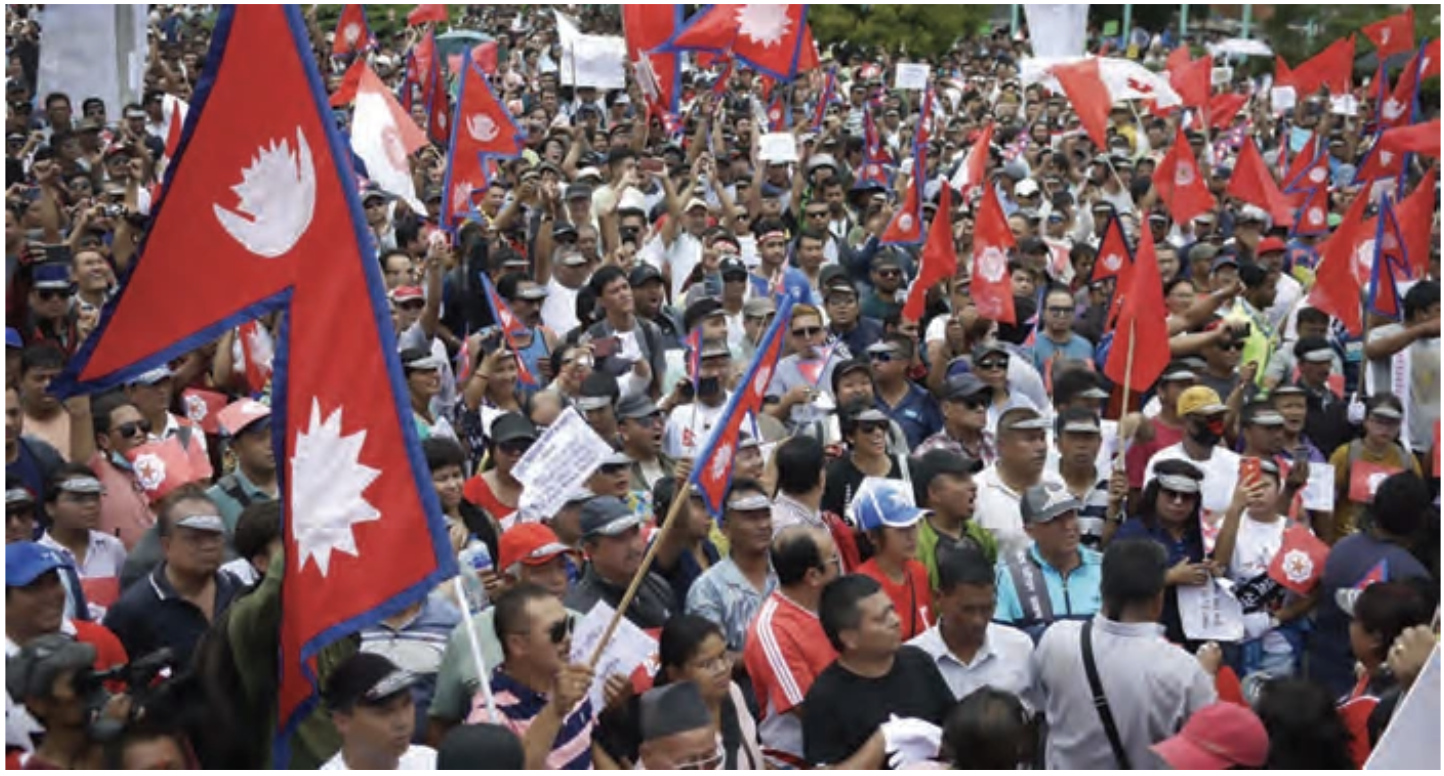
In September 2025, protests against the government escalated sharply. While multiple factors contributed to public dissatisfaction, demonstrators were particularly incensed by entrenched inequality and pervasive government corruption. For example, the Prime Minister’s family notably increased their wealth during his tenure, fueling public outrage. Protestors were particularly enraged by a photo of Saugat Thapa, son of politician Bindu Kumar Thapa, posing by a Christmas tree made out of boxes from designer brands. The protests turned extremely violent, resulting in extensive damage to hundreds of government buildings and causing approximately $21 billion in losses.
The immediate catalyst for the protests was the government’s ban of 26 social media platforms, including Facebook, Instagram, Youtube, and X. In response, protestors burned down the Parliament building, ultimately prompting the Prime Minister’s resignation. To expedite the formation of a new government, an election was conducted via Discord. Voter turnout was low, with only 7,500 participants out of a population of nearly 30 million. The election resulted in the appointment of Sushila Karki, former chief justice of the Supreme Court of Nepal, as the new Prime Minister.
Even before the collapse of Nepal’s government, the country’s stability was strained by competing U.S. and Chinese investments. China established diplomatic relations with Nepal in 1955, driven by concerns over potential annexation. More recently, China has intensified their relationship through increased investment in Nepal and joint military exercises. The U.S. has also sought to exert influence over Nepal, although with questionable success. In 2022, the U.S. State Partnership Program offered disaster relief to Nepal, which the government declined, citing concerns that the aid was intended to generate anti-Chinese sentiment. The U.S. did achieve some success through USAID, which has provided substantial support for Nepal’s economic and political development. However, the end of USAID funding, amounting to nearly $700 million in development assistance, may pose risks to the stability of Nepal’s newly elected government. Absent stable assistance from democratic nations, Nepal’s government may lack the infrastructure needed to survive as a democracy.
The competition between the U.S. and China over Nepal carries significant geopolitical consequences. The U.S. seeks to challenge Chinese influence in the Himalayan region, while China is particularly concerned about the U.S. support for Tibetan refugees, which China perceived as a form of aggression. Should China perceive a lack of resistance in the region, it is likely to further expand its influence. China’s current strategy leverages the Belt and Road Initiative to establish economic control over countries as a precursor to political influence. This dynamic also raises the potential for territorial disputes with India, which could escalate into armed conflict.
Democracy-building in Nepal also carries significant implications for U.S. credibility on the global stage. Failing to support emerging democracies undermines broader U.S. foreign policy objectives. Neglecting new democracies jeopardizes long-term interests in two key ways. First, it signals to other countries that democratic transitions may lack international support, potentially influencing China’s strategic vision in the future. Second, it weakens the foundation of the liberal international order that the U.S. seeks to uphold. When fragile democracies are overtaken by authoritarian superpowers due to a lack of external support, it reinforces the perception that authoritarian governance is more stable and effective than democratic governance.
Several measures can be undertaken to counterbalance Chinese influence in the region. First, the U.S. and its allies can significantly expand diplomatic engagement. Small, less powerful countries often struggle to maintain neutrality on the international stage, making effective diplomacy a crucial step in fostering cooperation with Nepal. Such diplomacy can help ensure that Nepal remains aligned with the U.S. and its partners while mediating relations between Nepal, China, and other regional actors. Additionally, the U.S. and its allies should prioritize strengthening Nepal’s institutional capacity to enhance Nepal’s resilience against potential Chinese influence and authoritarian pressures. Building robust institutions contributes to long-term stability by reducing Nepal’s vulnerability to political and economic turmoil in the future. Lastly, the U.S. should reinforce its regional containment strategy in the region through enhanced military cooperation with Nepal. Expanding U.S.-Nepal military cooperation does not necessarily require a large military presence. It could focus on training, disaster response, and technology sharing to diffuse, rather than escalate, tensions. For example, in September, the U.S. delivered M28 Skytrucks to Nepal, both strengthening bilateral relations and enhancing Nepal’s operational capabilities.
Nepal stands at a critical crossroads. The political and economic turmoil, demand for change, and regional tensions all create an opportunity for genuine change. However, as a young and fragile democracy, Nepal also faces many serious challenges. This is especially true given their proximity and strategic interest to China. However, the U.S. has an opportunity to support democracy in the region by committing to support Nepal, diplomatically, financially, and militarily.
References
Balachandran, P. (2022, June). Nepal backs away from US state-partnership program. The Diplomat. https://thediplomat.com/2022/06/nepal-backs-away-from-us-state-partnership-program/
Baniya, Bahadur Dharma. (2023). The Thriving Strategy for Nepal Amidst Triangular Competition of China, India, and the United States. Unity Journal, 4(1). https://doi.org/10.3126/unityj.v4i01.52234
Bhattarai, G., & Lamichhane, D. (2024). Twigging the US-China competition from the lens of offensive realism: Implications for Nepal. Journal of APF Command & Staff College, 7(1), 219-240. https://doi.org/10.3126/japfcsc.v7i1.67005
Bhattari K. (2022, May 25). US engagement with Nepal’s Tibetan refugees infuriating China. The Annapurna Express. https://theannapurnaexpress.com/story/25301/
Cannon, B. (2024, August 16). Geopolitics in the Himalayas: China’s strategy and what rimland states like India can do about it. Institute for Security & Development Policy. https://www.isdp.eu/geopolitics-in-the-himalayas-chinas-strategy-and-what-rimland-states-like-india-can-do-about-it/
Davis E. (2025, August 3). USAID closure harms pro-democracy development efforts in Nepal. The Kathmandu Post. https://kathmandupost.com/national/2025/08/03/usaid-closure-harms-pro-democracy-development-efforts-in-nepal
Fiscal Nepal. (2025, September 5). U.S. expands Nepal’s disaster response capacity with two new M28 Skytrucks. Fiscal Nepal. https://www.fiscalnepal.com/2025/09/05/22088/u-s-expands-nepals-disaster-response-capacity-with-two-new-m28-skytrucks/
Gupta, R. (2022, July 27). The US-China contest in Nepal. ThinkChina - Big Reads, Opinions & Columns on China; Think China. https://www.thinkchina.sg/politics/us-china-contest-nepal
Kharel, S. (2025, September 15). More egalitarian: How Nepal’s Gen Z used gaming app Discord to pick PM. Al Jazeera. https://www.aljazeera.com/news/2025/9/15/more-egalitarian-how-nepals-gen-z-used-gaming-app
Kunwar, Nawaraj Bikram. (2023). Evolving Security Landscape of Nepal-China Relations. Journal of APF Command & Staff College, 6(1). https://doi.org/10.3126/japfcsc.v6i01.57590-discord-to-pick-pm
Mulmi, A. R. (2025, September 24). From streets to Discord: How Nepal’s Gen Z toppled a government. Carnegie Endowment for International Peace. https://carnegieendowment.org/research/2025/09/nepal-gen-z-topple-government
Ngo, T. (2025, July 11). The USAID Shutdown: Stories From Colombia, Kenya, and Nepal. Think Global Health. https://www.thinkglobalhealth.org/newsletter/friday-11-jul-2025
Pant, S. (2025, March 26). Navigating Nepal’s Indo–China and US relations. Farsight Nepal. https://farsightnepal.com/news/navigating-nepals-indo-china-and-us-relations/
Prasain, K. (2025, September 5). Only Hamro Patro, X respond as Nepal bars 26 social sites. The Kathmandu Post. https://kathmandupost.com/national/2025/09/05/only-hamro-patro-x-respond-as-nepal-blocks-26-social-media-platforms-1757082149
Rama P. (2025, September 16). Nepal Gen-Z protests: Politicians get rich while we suffer - so I helped bring down the government in 48 hours. BBC. https://www.bbc.com/news/articles/cvg9n760gddo
Rijal, A. (2022, August 10). Opportunities and Challenges of Migration for Nepal. Nepal Economic Forum. https://nepaleconomicforum.org/opportunities-and-challenges-of-migration-for-nepal/
Reuters Staff. (2025, September 9). Nepal’s history of political instability. Reuters. https://www.reuters.com/business/media-telecom/nepals-history-political-instability-2025-09-09/
Stanton, A. (2025, September 9). Why Gen Z Is Revolting in Nepal to Overthrow Government. Newsweek. https://www.newsweek.com/gen-z-nepal-protests-2127266
Weber, M. (2025, January 7). Democracy and Human Rights in U.S. Foreign Policy: Evolution, Tools, and Considerations for Congress. Congressional Research Service. https://www.congress.gov/crs-product/R47890
World Bank Group. (2025). GDP Growth (annual %). Worldbank.org. https://data.worldbank.org/indicator/ny.gdp.mktp.kd.zg


.svg)