

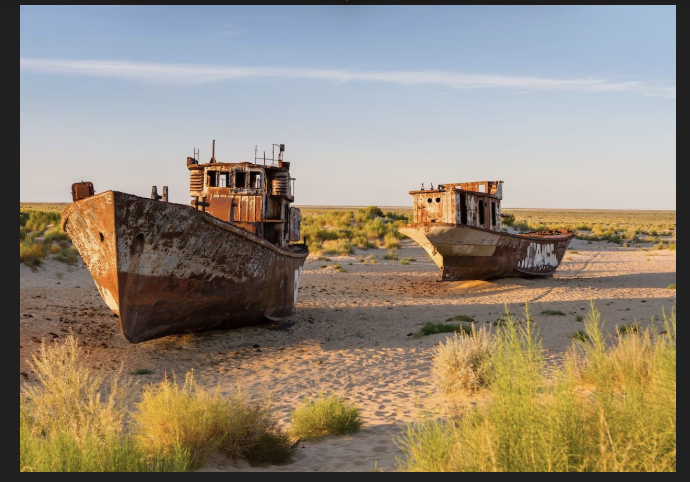
Once the world’s fourth-largest inland sea, the Aral Sea spanned 68,000 square km, an area about the size of Ireland. Today it has mostly vanished, stretching out as a cracked salt slat where rushed ships lie stranded in sand dunes. In the 1960s, the Soviet Union diverted the Aral’s lifelines—the Syr Darya and Amu Darya rivers—into massive irrigation canals to farm cotton and rice in the desert. The short-term harvest was bountiful, but by the 2000s, the lake had lost over 90% of its area and splintered into shrunken remnants. Fisheries collapsed, ports were left dry, and an ecological catastrophe was set in motion.
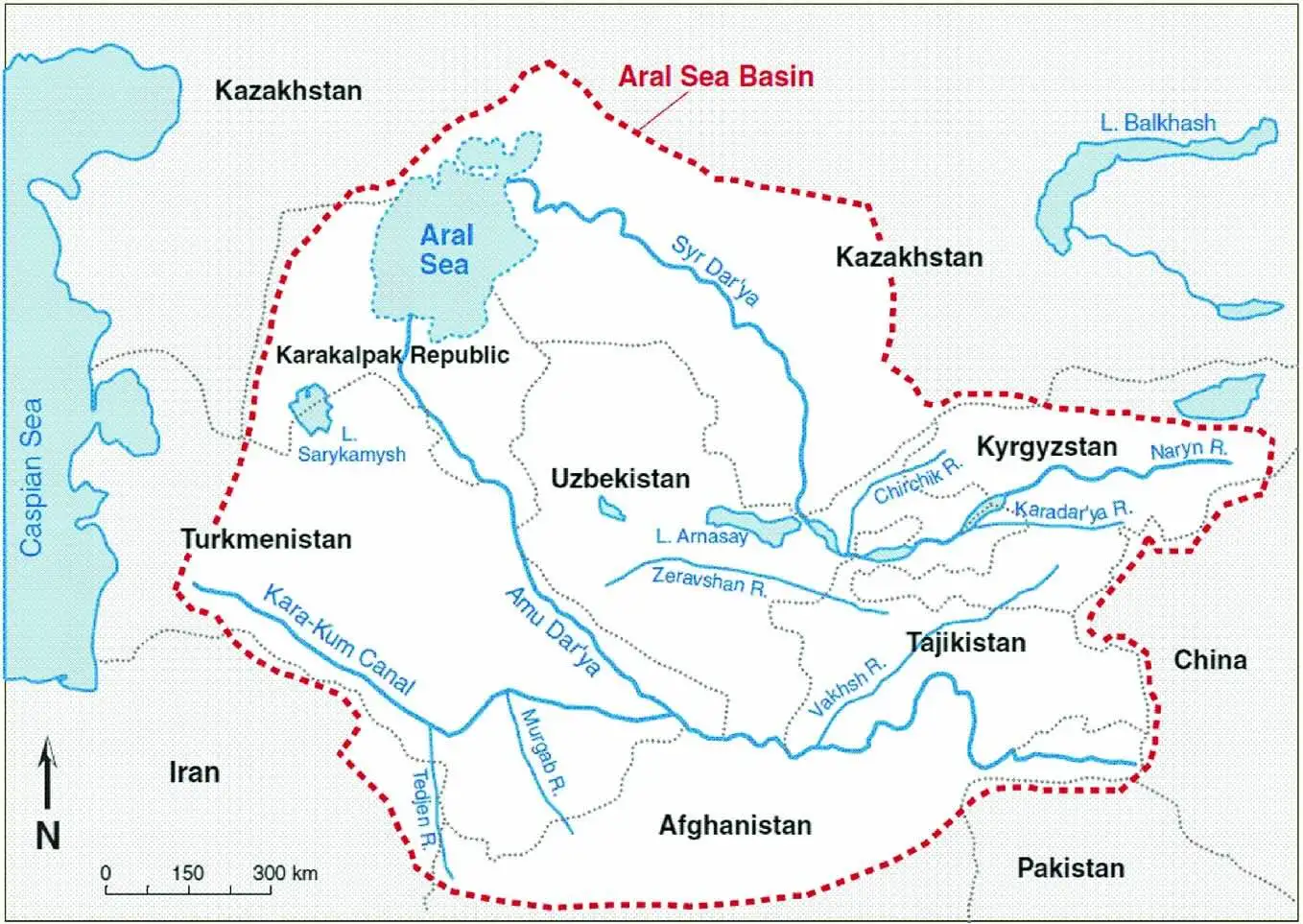
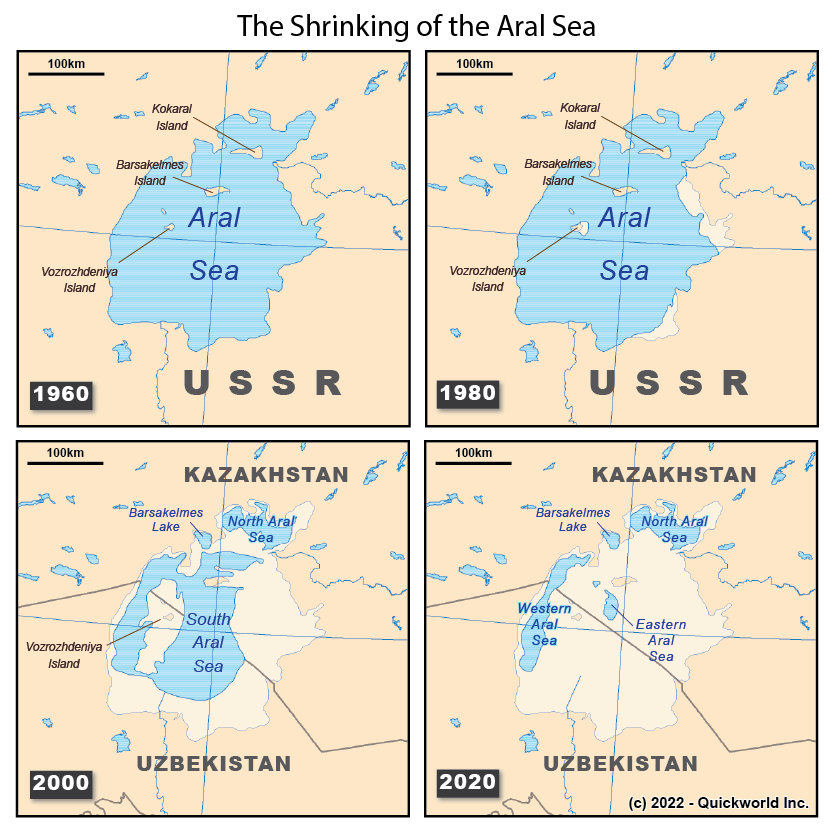
Aral Sea Shrinkage Regional Location
Today, nascent restoration efforts are slowly reshaping parts of the landscape. The question now is whether this partial revival can last, and whether the world will treat the Aral Sea as a model for environmental recovery, or as a dire warning of what happens when short-term development trumps sustainability.
Historical Context and Collapse
For centuries, the Aral Sea was a vibrant oasis in Central Asia: fed by snowmelt rivers from the Pamir and Tien Shan mountains, teeming with fish and wildlife, supporting a prosperous fishing industry and port towns like Aralsk and Muynak. In the mid-20th century, however, Soviet planners fixated on cotton, known as “white gold”, as the key to transforming Central Asia’s economy. The regime undertook one of the world’s most extensive irrigation schemes, doubling the region’s irrigated farmland from 4-5 million hectares in 1960 to nearly 8 million by the mid 2000s. Vast canal networks, often unlined and leaky, were carved into the desert to siphon water from the nearby Amu Darya and Syr Darya rivers and onto cotton and rice fields. As a result, the Aral Sea’s river input was cut off and over 75% of the rivers’ flow was diverted for agricultural irrigation by the 1960s.
With inflows throttled, the Aral Sea began receding rapidly during the 1970s and 1980s, evaporating faster than it could be replenished. By 1989, the water had dropped so far that the lake split in two: the Small (North) Aral in Kazakhstan, and the Large (South) Aral in Uzbekistan. Salinity skyrocketed to triple its former level, wiping out the native fish species and ending what had been a 40,000-ton annual fishery. By the early 2000s, the Aral Sea had lost roughly 75 feet of water depth and over 90% of its volume, leaving only a small northern vestige behind an emergency dike. Satellite images in 2014 captured the grim milestone of the eastern basin of the South Aral completely desiccating, exposing a salt-caked plain.
The ecological collapse was accompanied by cascading social and environmental crises. As the waters retreated, they left behind a toxic powder keg: the dry seabed, now called the Aralkum Desert, held decades of accumulated salts, fertilizers, and pesticides like DDT from the region’s industrial farming. Strong winds began lifting this poisoned dust into the atmosphere, creating salt-dust storms that dispersed pollutants across hundreds of kilometers. The high salinity and salt dust storms have turned the once-fertile delta wetlands into barren salt flats. Farm fields downwind became increasingly infertile as saline dust settled on them; farmers had to flush their soils with even larger volumes of water to rinse out salt, further wasting precious water in a vicious cycle.
Communities around the Aral Sea were devastated. Local economies, like in Muynak, once based on fisheries and canneries, collapsed; an estimated 50,000 to 100,000 jobs were lost as the lake dried. Unemployment and poverty spiked; 74% of the population in the disaster zone fell below the poverty line in the 2000s. The public health situation nosedived as well, creating what the UN Secretary-General in 2010 called “one of the worst environmental disasters in the world.” The Aral Sea’s destruction was not just an ecological loss—it was the product of a state-led, extractivist approach to development that ignored local realities and long-term costs. The Soviet Union "achieved" its cotton monoculture, but at the irreversible expense of an entire region’s environment and well-being.
Governance and Transboundary Water Politics
After the collapse of the USSR, the newly independent Central Asian republics suddenly faced the Aral Sea crisis as a shared challenge. In 1993, all five states (Kazakhstan, Uzbekistan, Turkmenistan, Tajikistan, Kyrgyzstan) formed the International Fund for Saving the Aral Sea (IFAS) to coordinate a response. Over the years, IFAS developed joint action plans, the latest being the Aral Sea Basin Programme (ASBP-4, 2021-2030), outlining goals for water conservation, basin management, and ecosystem restoration. In practice, however, regional cooperation has been fraught with difficulty. Each country has guarded its own water interests: upstream nations Kyrgyzstan and Tajikistan prioritize hydropower (storing water in reservoirs for winter electricity), while downstream nations Uzbekistan and Turkmenistan depend on maximum summer irrigation releases. This tension has halted collective water management. IFAS, meant to be the vehicle for basin-wide governance, has often struggled to overcome divergent national agendas and a legacy of distrust.
In recent years, Kazakhstan, which holds the Small Aral within its borders—has emerged as the strongest advocate for reviving the sea. Under Kazakhstan’s IFAS chairmanship, which began in 2024, the country has pushed for the modernization of water management, including prioritizing digital monitoring systems and data-sharing among the neighbors in order to improve transparency and build trust. Kazakh officials emphasize that only coordinated, basin-wide action can prevent further disasters. In October 2025, Kazakhstan’s Prime Minister noted that “Each country has its own interests . . . but our common long-term priority is good neighborly relations,” insisting that short-term needs, like in the form of water hoarding, cannot undermine long-term regional sustainability. That same month, at a high-level IFAS board meeting in Astana, Kazakhstan reported over 40 environmental projects underway in the Aral Sea basin and proposed holding a summit of Central Asian heads of state to reinvigorate IFAS’s mission. It also suggested symbolically designating March 26 as an “International Day of the Aral Sea and its Rivers” to rally attention.
External partners are adding momentum as well. In 2021, Uzbekistan sponsored a UN resolution declaring the Aral Sea region a zone of ecological innovations and technologies, seeking international support for development programs. Additionally, in 2022-2025, Switzerland launched the Blue Peace Central Asia initiative—a multilateral effort to bolster regional water cooperation through improved science and information-sharing.
Long-term diplomatic initiative, Blue Peace, originally launched by Switzerland, promotes transboundary water management as a tool for peace, security, and sustainable development - turning competition over water resources into cooperation. Their Phase 2 Program (running 2025-2029) is funding hydrological research, open data platforms, and dialogues among the five countries. By promoting transparency in water data and a shared understanding of the basin’s climate risks, it aims to transform water from a source of conflict into an instrument of collaboration.
Ultimately, progress will depend on balancing national sovereignty with recognition that the Aral Sea is a single interconnected system. As one regional expert noted, if upstream countries don’t release enough water, no amount of downstream effort can save the Aral. Governance, therefore, must extend beyond borders for any revival to last.
Ecological and Environmental Restoration Efforts
Despite the bleak overall picture, the Aral Sea has seen some remarkable (if partial) ecological rebounds, notably in its northern Small Area due to targeted restoration projects. The most celebrated effort is the Dike Kokaral, a 12 km long dam completed in 2005 with funding from the World Bank and Kazakhstan. The dam was built on the narrow channel between the North and South Aral Seas, effectively sealing off the North Aral to prevent water from draining into the lower basin. By impounding the flow of the Syr Darya in the north, the Kokaral project quickly delivered results: within months, the shrunken North Aral Sea’s level rose 4 meters, and its salinity plummeted from a lethal ~30 g/L toward more normal brackish levels. Over the ensuing years, the surface area expanded, and the water volume steadily increased—by 22 billion cubic meters by 2025, up from 18.9 bcm in 2022, according to Kazakhstan’s Ministry of Water. The ecological payoff has been tremendous. Several native fish species, including pike-perch, flounder, and carp, have re-colonized the North Aral as salinity fell, and the revived lake now supports a slowly growing commercial fishery. In the once-abandoned port of Aralsk, Kazakhstan, small fishing boats have reappeared and locals report families who migrated away for work are starting to return as the fish catch surges. Annual fish harvests in the North Aral have risen more than tenfold since the early 2000s, reviving incomes and food security for surrounding communities.
On land, large-scale afforestation programs are striving to turn the dried lakebed of the Aralkum Desert green. Both Kazakhstan and Uzbekistan have invested heavily in planting saxaul and other drought-tolerant shrubs across the former seabed to stabilize the soil. Kazakhstan’s campaign has planted some 475,000 hectares (ha) of saxaul from 2021 to 2024, with another 428,000 ha planned in 2025. In 2020, Uzbekistan announced it had already afforested and met a Bonn Challenge restoration target a decade early.
The primary goal is to curb the devastating dust storms by creating vegetative cover that holds down sand and salt; however, the benefits extend beyond dust control. The newly planted vegetation has strong potential to drastically improve soil and create micro-habitats for wildlife.
Satellite data confirms patches of greenery are slowly expanding on parts of the dry lakebed. In recognition of these gains, the UN and World Bank have hailed the Aral seabed afforestation as a model for fighting desertification. One World Bank study estimates restoring vegetative cover in the Aralkum could prevent $39 million per year in lost ecosystem services by protecting agriculture, air quality, and capturing millions of tons of carbon dioxide in the biomass and soils.
Multiple innovative projects support these restoration efforts. The USAID Environmental Restoration of the Aral Sea (ERAS) program, for instance, completed a first phase on the Kazakh side and launched ERAS-II in late 2022 focused on the Uzbek side. ERAS-II is testing a variety of approaches across different zones of the dry seabed, from highly saline flats to former shoreline areas, to find what mix of salt-tolerant plant species, soil treatments, and irrigation techniques work best under each condition. The project not only aims to re-establish vegetation but also to engage local communities in caretaking the new “forest,” thus providing jobs and know-how. There is no one-size-fits-all fix; constant learning and adaptation are needed to “beat the desert”.
Looking Forward
Despite these positive strides, ecological recovery remains uneven across the Aral Sea’s territory. The South Aral Sea in Uzbekistan, which receives the Amu Darya’s trickle, has not been saved by any comparable engineering efforts and continues to shrink. By the 2010s, it fragmented into a handful of hypersaline puddles—essentially brine lakes with salinity so high almost no fish or large fauna can survive. The largest residual waterbody in the south is now a narrow western sliver of the former Aral, now often called the West Aral Sea, which is heavily salinic and prone to further evaporation. Much of the vast eastern basin turned into desert by 2014. Uzbekistan’s efforts have therefore focused on mitigation: stabilizing the dust and promoting alternative livelihoods, rather than attempting to refill the southern lake. The government declared the Aral region a special zone for “environmental innovation and technology” attracting UN support for projects in solar energy, ecotourism, and sustainable agriculture to help local people adapt. New small lakes and wetlands have been created in parts of the Amu Darya delta to support irrigated farming and aquaculture on a limited scale. However full restoration of the South Aral is now considered unfeasible under current water availability.
The contrast between the North and South Aral Seas is stark. Only where consistent governance, sustained investment, and long-term maintenance have been provided–most notably in Kazakhstan's North Aral–has ecological recovery proven possible. Reactive policies and limited resources, as seen in southern Uzbekistan, have left much of the South Aral effectively beyond recovery. Looking forward, the durability of the North Aral’s revival will depend on whether regional cooperation can be institutionalized through bodies like IFAS and reinforced by data-sharing and water efficiency initiatives such as Blue Peace. Without basin-wide coordination to modernize irrigation, reduce water waste, and manage intensifying climate pressures, gains in the north remain fragile and isolated. The Aral Sea’s future, therefore, remains unresolved: it may endure as a rare example of partial environmental recovery, or stand as a lasting warning that without sustained, collective governance, even the most ambitious restoration efforts cannot fully overcome the legacy of environmental collapse.
References and Sources Consulted
Abbott, Ben. “Overview of the Aral Sea Disaster | Grow the Flow - Utah.” Growtheflowutah.org, 2025. https://growtheflowutah.org/2025/08/27/overview-of-the-aral-sea-disaster/.
Abulu, Latoya. “Uzbekistan Plants a Forest Where a Sea Once Lay.” Mongabay Environmental News, May 29, 2024. https://news.mongabay.com/2024/05/uzbekistan-plants-a-forest-where-a-sea-once-lay/.
Artman, Vincent. “Water Politics and the Human Geographies of the Aral Sea Crisis.” Georgetown Journal of International Affairs, September 18, 2020. https://gjia.georgetown.edu/2020/09/18/water-politics-and-the-human-geographies-of-the-aral-sea-crisis-2/.
Asia. “USAID Oasis Project on Course to Restore Aral Sea Ecosystem - the Times of Central Asia.” The Times Of Central Asia, April 12, 2024. https://timesca.com/usaid-oasis-project-on-course-to-restore-aral-sea-ecosystem.
Chen, Dene-Hern. “The North Aral Sea Teems with Fish Thanks to Restoration Projects.” Science, March 16, 2018. https://www.nationalgeographic.com/science/article/north-aral-sea-restoration-fish-kazakhstan.
Group, World Bank. “Greening the Desert: The Role of Landscape Restoration in Uzbekistan’s Battle against Sand and Dust Storms.” World Bank. World Bank Group, December 10, 2024. https://www.worldbank.org/en/news/feature/2024/12/04/greening-the-desert-the-role-of-landscape-restoration-in-uzbekistan-s-battle-against-sand-and-dust-storms.
Haidar, Aliya. “Kazakhstan Urges Regional Cooperation to Save the Aral Sea - the Times of Central Asia.” The Times Of Central Asia, October 17, 2025. https://timesca.com/kazakhstan-urges-regional-cooperation-to-save-the-aral-sea/.
Harriman, Lindsey. “The Future of the Aral Sea Lies in Transboundary Co–Operation.” World Meteorological Organization, November 12, 2015. https://wmo.int/media/magazine-article/future-of-aral-sea-lies-transboundary-co-operation.
International Water Management Institute. “Blue Peace Central Asia.” International Water Management Institute (IWMI), September 26, 2025. https://www.iwmi.org/projects/bpca/.
Kemelova, Fatima. “Aral Sea: Record Water Inflows and Greening Initiatives Fuel Environmental, Economic Recovery - the Astana Times.” The Astana Times, February 10, 2025. https://astanatimes.com/2025/02/aral-sea-record-water-inflows-and-greening-initiatives-fuel-environmental-economic-recovery/.
———. “Desert Rebirth: Kazakhstan and USAID’s Aral Sea Restoration Partnership - the Astana Times.” The Astana Times, April 20, 2024. https://astanatimes.com/2024/04/desert-rebirth-kazakhstan-and-usaids-aral-sea-restoration-partnership.
———. “Kazakhstan Calls for Collective Action to Revive the Aral Sea and Strengthen Water Security - the Astana Times.” The Astana Times, October 13, 2025. https://astanatimes.com/2025/10/kazakhstan-calls-for-collective-action-to-revive-the-aral-sea-and-strengthen-water-security/.
Kruzman, Diana. “Environmental Disaster and Hopeful Revival in Central Asia.” New Lines Magazine, October 17, 2025. https://newlinesmag.com/essays/environmental-disaster-and-hopeful-revival-in-central-asia/.
Kwan, Sergey. “Kazakhstan Continues Afforestation Efforts on the Aral Sea - the Times of Central Asia.” The Times Of Central Asia, January 23, 2025. https://timesca.com/kazakhstan-continues-afforestation-efforts-on-the-aral-sea.
Maksym Sushchuk. “The Aral Sea’s Rebirth: Hope Blooms.” EOS Data Analytics. EOS Data Analytics, July 9, 2024. https://eos.com/blog/the-aral-seas-rebirth-hope-blooms/.
Manschadi, A.M. “‘White Gold’ and Aral Sea Disaster – towards More Efficient Use of Water Resources in the Khorezm Region, Uzbekistan - Lohmann Breeders.” Lohmann Breeders, 2020. https://lohmann-breeders.com/lohmanninfo/white-gold-and-aral-sea-disaster-towards-more-efficient-use-of-water-resources-in-the-khorezm-region-uzbekistan/.
NASA. “World of Change: Shrinking Aral Sea.” Nasa.gov. NASA Earth Observatory, n.d. https://earthobservatory.nasa.gov/world-of-change/AralSea.
Quickworld’s Map of the day. “The Drying of the Aral Sea,” July 13, 2022. https://mapoftheday.quickworld.com/posts/the-drying-of-the-aral-sea.
UNDP Uzbekistan. “UNDP ‘Green Aral Sea’ Initiative Continues next Stage of Aral Sea Ecosystem Restoration Using Innovative Methods.” UNDP, 2025. https://www.undp.org/uzbekistan/green-aral-sea.



.svg)