

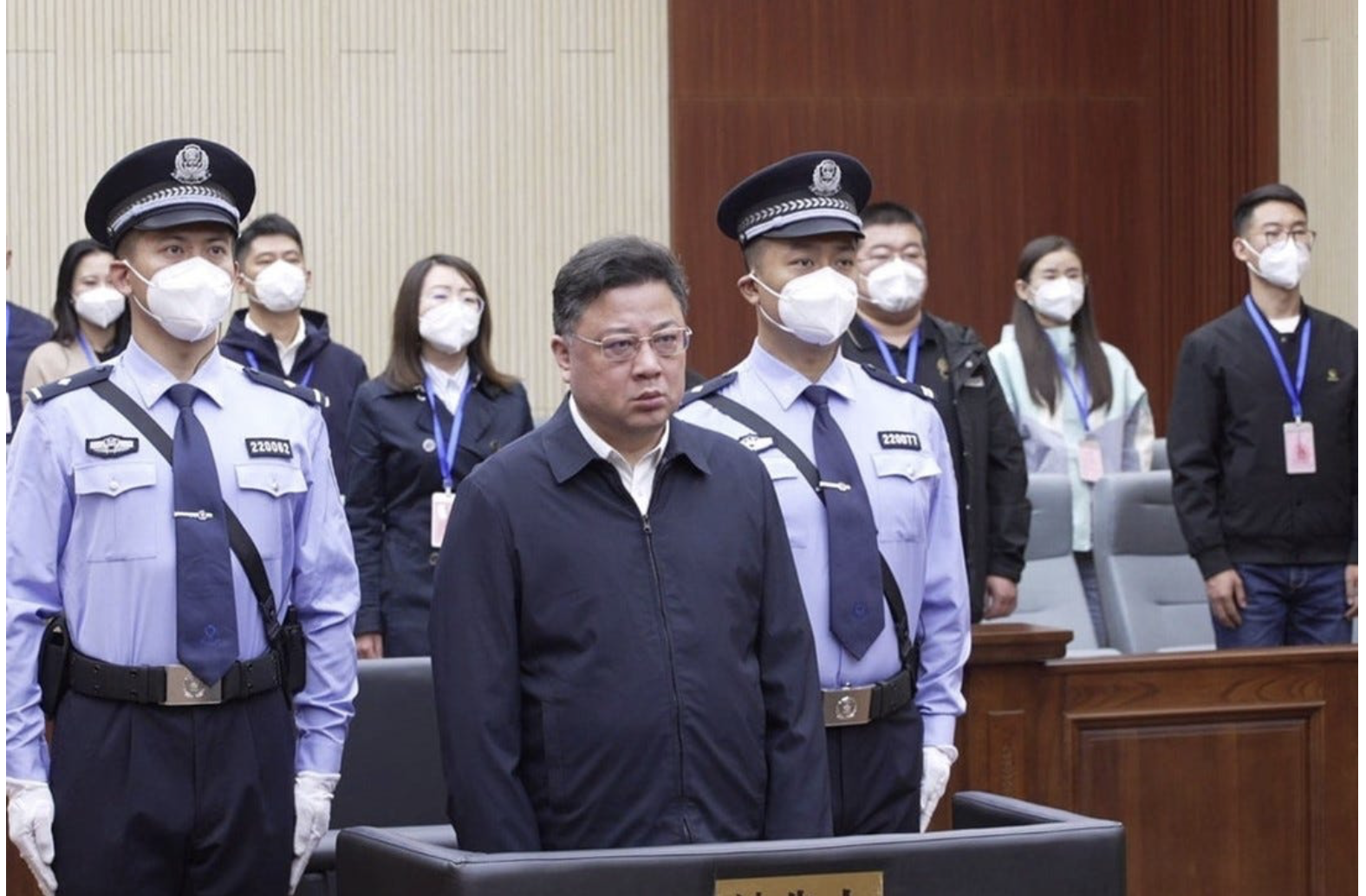
In October 2025, the Chinese Communist Party (CCP) expelled the nation’s second-highest ranking general and eight other senior officials due to allegations of corruption. The Chinese Defense Ministry cites suspicions of serious crimes such as embezzlement or treason. Few details were provided regarding the charges and sentences for the alleged crimes. Critics argue that anti-corruption was a front for a more political ulterior motive: purging the CCP of President Xi Jinping’s enemies. These continued arrests are a sign of growing discord and paranoia within the CCP, which show no signs of stopping.
Anti-corruption purges of government officials have been a staple policy of President Xi Jinping’s government since he took power in 2012. Between 2012 and 2021, the CCP investigated 77 National Leaders, 218 Departmental State Council leaders, 880 Provincial Leaders, and 1332 Prefecture Leaders for corruption, including both “flies” (low-level officials) and “tigers” (high-ranking officials). But after fourteen years, the CCP’s anti-corruption accusations show no signs of stopping. The CCP reported that almost one million party officials had been disciplined, fired, or even jailed during 2025 alone due to corruption charges.
China has been plagued by government corruption for decades. During the Mao regime, corruption mainly took place in the form of embezzlement of public funds by local or provincial government officials. Over the years, as China transitioned towards a market economy, corruption rose due to collusion between politicians and corporate leaders. Additionally, prior to President Xi’s administration, anti-corruption endeavors were neither effective nor widespread enough to make an impact, making corruption a salient issue for citizens.
Former President Hu Jintao named corruption among party members the largest threat to the nation. In 2012, a shocking set of bribery and murder accusations brought down Bo Xilai, Xi Jinping’s biggest rival for the presidency. The following years brought various more groundbreaking corruption arrests, including China’s head of security and Hu Jintao’s personal aide. Since then, ridding the CCP of corruption has become President Xi’s keynote policy. Corruption, once considered a mere violation of the law, is now treated as a political crime of disloyalty to the party itself. Furthermore, the CCP state-run media frames corrupt politicians as political enemies of the state. For example, the Xinhua News Agency said of the former Internet Regulation Agency director, who was arrested for corruption in 2018: “Lu Wei has completely lost his ideals, political beliefs, and commitment to the Party’s principles.”
President Xi’s goal is to create a bureaucracy of rule followers untouched by corruption. These anti-corruption purges are also widely politically popular, so they serve as an easy method to ramp up support among the public in difficult times. Citizens exposed to the anti-corruption campaign report a lower level of perceived corruption and higher satisfaction with the campaign. Additionally, anti-corruption is associated with higher approval of government performance as a whole and specific governance items. Sometimes, these arrests are used to target the President’s political opponents, creating a party landscape of exclusively the President’s loyalists. But the political nature of these regular arrests does not negate the corruption of the officials targeted. A 2024 study found that, among a sample of officials charged with corruption between 2012 and 2021, practically all were among the top 5% of China’s income distribution when taking illicit funds and bribery into account. If illicit funds were excluded, only half were in the top 5%. Officials accused of corruption tend to be wealthy and powerful. The level of alleged corruption of an official is correlated with education, role in party hierarchy, and years of membership in the party.
Recent scholarship finds that the anti-corruption efforts have indeed reduced rent-seeking and graft among the CCP bureaucracy. The arrests are also associated with a decline in the consumption of luxury goods and wines, common objects used for bribery of public officials. Close relations between entrepreneurs and politicians have waned. Cases of favoritism for public officials in land sales have declined, as have government subsidies towards closely related corporations.
In 2019, President Xi declared a “crushing victory” over graft. But today, anti-corruption arrests have not slowed, despite the aforementioned successes. Of the 1 million officials investigated for corruption in 2025, 983,000 were punished. The number of investigations in 2025 was 15% higher than in 2024 and 60% higher than in 2023. Clearly, regardless of the political motives behind such investigations, corruption in China still remains. The nation’s armed forces are a breeding ground of corruption due to their networks of personal loyalty. The problem of buying posts in the military remains rampant. Among civilians, promotion-buying continues as well.
The number of anti-corruption investigations is rising because President Xi is spearheading investigations in even the lowest ranks of the CCP bureaucracy. The commission has investigated low-level party members and small business owners on bribery charges. Bribery and gift-giving crimes have increased as a proportion of all investigations. Additionally, penalties for corruption are getting harsher. In 2014, 30% of investigations led to arrest or expulsion from the party. By 2024, this number had risen to 70%. The number of suspects held without charges in hopes of premature confessions has increased by 46%. Incarceration often involves solitary confinement, torture, and death by suicide.
While these numbers may seem like a step in the right direction, the expansion of anti-corruption may have backfired. The constant fear of investigation may have exacerbated “small-circle politics,” where public officials shrink their professional circles out of fear of incarceration. Officials may rely more greatly on existing personal connections, reinforcing a culture of informality that acts as a breeding ground for quid pro quo. Thus, corruption may not be stamped out, but simply more difficult to detect.
As investigators go after ordinary party members and businesspeople, and as corrupt officials learn to hide their bribes, the game of cat-and-mouse will continue. The anti-corruption campaign has been, by conventional metrics, wildly successful. Bribery, collusion, and quid pro quo are all down, and yet the arrests have not slowed. This begs the question: how long can the arrests last? It seems that so long as bribery occurs, so will the arrests. But President Xi is incentivized to continue his efforts indefinitely. Anti-corruption arrests are incredibly politically popular among the Chinese people. Such arrests often bolster nationalism and pro-CCP sentiment by identifying a set of national enemies, fostering unity. Due to the inevitability of corruption and the popularity of anti-corruption, it is unlikely that President Xi Jinping’s campaign of anti-corruption arrests will subside anytime soon.


.svg)