

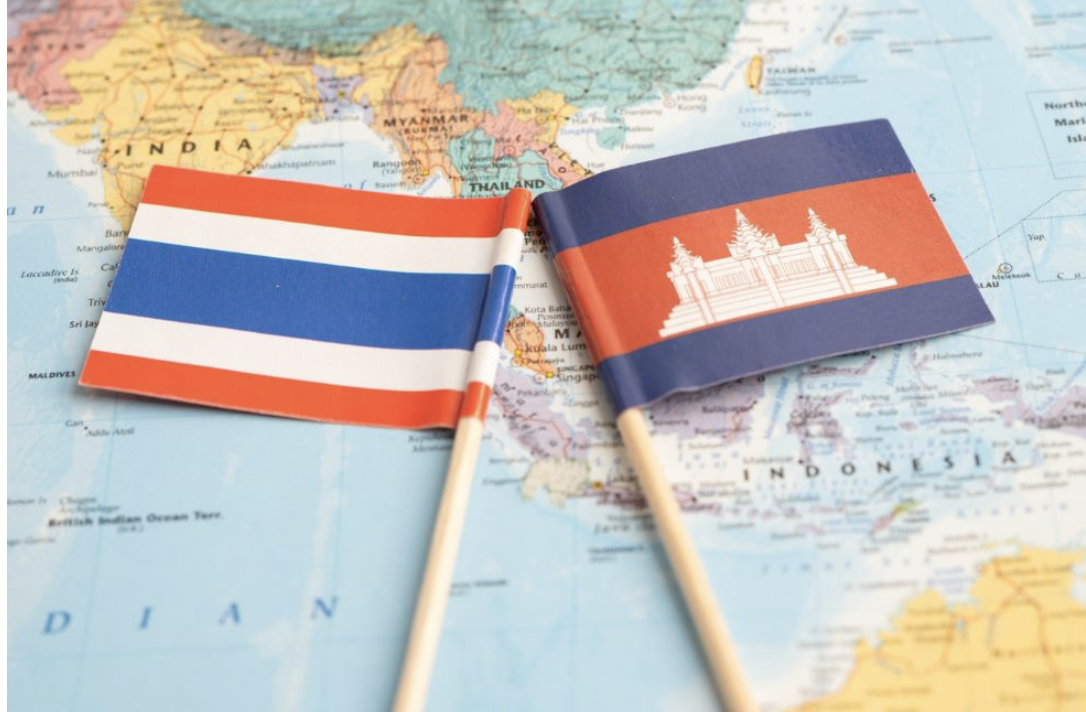
Tensions between the Southeast Asian kingdoms of Cambodia and Thailand have simmered since the mid-20th century. Competing land claims over undefined border areas have existed for decades. When France colonized Cambodia in the 19th century, borders with Thailand were drawn that didn't satisfy either side (Teekah, 2026). Some areas with mixed or disputed populations were assigned to one country or the other, planting seeds for future disputes. Diplomatic relations between Thailand and Cambodia reached a nadir in the summer of 2025, when border skirmishes over a disputed temple, an ancient religious site that both nations claimed territorial claim over, resulted in the death of a Cambodian soldier. Shortly after, six Thai soldiers were injured by landmines near the Thai-Cambodian border, further intensifying tensions between the two countries (Security Council Report, 2025). United States President Donald Trump has positioned himself as a global peace broker in his second term and has publicly sought to end the fighting.
In the weeks following the intensification of the conflict in July 2025, President Donald Trump threatened to "freeze all trade" and impose 36-49% tariffs on both countries, tariff levels that would have been detrimental to these export-heavy economies (Bloomberg, 2025). Cambodia and Thailand are some of the world's leading textile manufacturers, with American companies using the countries' cheap labor resources to create their textile products in-country and then import to the United States (CNBC, 2025). High tariffs would make these goods more expensive for American companies, and textile companies would look to move out of Cambodia and Thailand to countries with less restrictive tariff restrictions. Consequently, Cambodia and Thailand agreed to the "July 28 Ceasefire" shortly after this economic ultimatum was issued. As a result, Trump claimed his place as the world's premier peacemaker, citing his ending of the Thai-Cambodian conflict as a basis for claiming the inaugural "FIFA Peace Prize" (Newsweek, 2025). Trump has also cited his role in the Israel-Palestine ceasefire as evidence of his peacemaking prowess and thus of his merit for the Peace Prize.
But what role did President Trump actually play in forging a lasting peace between these warring Southeast Asian nations? The reality in Cambodia and Thailand is one of diplomatic fragility, a sharp contrast to the haven of peace that Trump proclaims the region to be on account of his actions. The initial July ceasefire, agreed to by both involved countries, fractured in the months after signing. When skirmishes again broke out, another ceasefire termed "The Kuala Lumpur Peace Accords" was brokered (Teekah, 2026). However, peace lasted just six weeks before heavy fighting resumed in December of that year. As Al Jazeera reported, Thailand struck in retaliation for the killing and wounding of Thai soldiers along the border (Al Jazeera, 2025). This is a military death that directly undermines Trump's claims that his negotiated peace in Southeast Asia is successful. The human cost of these repeated failures is stark: more than 500,000 civilians from both countries were ultimately forced to flee the violence at the border (Al Jazeera, 2025).
If President Trump's deals continuously dissolve, his effectiveness as the "President of Peace" in creating durable, long-lasting resolutions to conflicts could be called into question. While much publicity has been made of the two public peace deals, Trump has been unusually silent on the renewed fighting. The fighting continues into 2026, and no public comments have been made by the Trump administration regarding the resumption in fighting or efforts to forge another peace deal. The Trump administration's emphasis has been placed largely on the announcement of these deals, with less immediate focus on their specific terms (TIME, 2025).
While Trump is likely to continue promoting his accomplishments around the world as the "President of Peace," the Thai-Cambodian conflict cannot be touted as one of those achievements while bullets continue to fly. Much ado has been made of Trump's ability to bring an end to the world's most contentious battles, but the duration of the peace he brings is questionable. His deals have collapsed in Southeast Asia in just six weeks, while it remains to be seen if the Israeli-Hamas ceasefire his administration brokered late last year will be permanent. Experts have drawn a sharp distinction here: what Trump brokers are ceasefires, not peace agreements, and "with the ceasefire, it can flare up into fighting at any moment" (NPR, 2025). Hence, we must view President Trump as a broker of temporary peace, rather than as a cultivator of permanent conflict solutions.
To understand why Trump's peacemaking failures carry impact beyond Southeast Asia, one must understand the nature of Trump's ambitions. Trump's pursuit of the "President of Peace" label is itself a foreign policy posture, one that prioritizes the announcement of a peace deal over subsequent implementation. In a global environment where American credibility as a mediator influences how American allies and adversaries calculate risk, the distinction between a public relations stunt and true implementation of a peace deal matters. Analysts have observed that the peace deals Trump secured relied primarily on U.S. trade leverage rather than substantive diplomatic engagement (TIME, 2025). When deals brokered by an imperial power such as America collapse, it signals to the world that American diplomatic engagement is conditional and perhaps performative, hence weakening American credibility abroad.
Ultimately, President Trump's failings to broker a lasting peace for the Thai-Cambodian conflict expose a glaring distinction between brokering a temporary, unstable ceasefire and achieving lasting peace. Trump's economic leverage proved effective in halting the initial fighting, and in a trend that has defined the President's second administration, Trump was quick to claim credit before the conflict had fully simmered out. The rapid collapse of both the July ceasefire and the subsequent Kuala Lumpur Peace Accords later that year reveals that short-term pressure, however forceful, is no substitute for the substantial and sustained diplomatic engagement that durable peace requires. With fighting continuing into 2026 and the Trump administration offering no public solvency, the region remains mired in instability. The "President of Permanent Peace" label may serve Trump's political brand, but in Southeast Asia, war still endures. Whether his other, more publicly celebrated deals, such as the Israeli-Hamas ceasefire, prove more lasting will be a better test of his legacy as a global mediator.
Works CIted
Al Jazeera. (2025, July 24). What we know about clashes on the Thai-Cambodian border. https://www.aljazeera.com/news/2025/7/24/what-we-know-about-clashes-on-the-thai-cambodian-border
Al Jazeera. (2025, December 11). Deaths mount on fourth day of border fighting between Thailand, Cambodia. https://www.aljazeera.com/news/2025/12/11/cross-border-fighting-between-thailand-cambodia-enters-fourth-day
Bloomberg. (2025, August 1). Trump sets 19% tariff on Thailand, Cambodia after peace deal. https://www.bloomberg.com/news/articles/2025-07-31/trump-sets-19-tariff-on-thailand-cambodia-after-peace-deal
CNBC. (2025, April 8). Cambodia hit with highest Trump tariff but manufacturing 'absolutely not' coming back to U.S., trade group says. https://www.cnbc.com/2025/04/08/trump-tariffs-cambodia-manufacturing-reshoring-us.html
Newsweek. (2025, December 5). Donald Trump awarded first FIFA peace prize during 2026 World Cup draw. https://www.newsweek.com/world-cup-draw-fifa-donald-trump-peace-prize-11164671
NPR. (2025, December 12). Trump touts his peace deals—but many are already unraveling. https://www.npr.org/2025/12/12/nx-s1-5638509/trump-peace-deals
Security Council Report. (2025). Cambodia-Thailand border clashes: Urgent private meeting. https://www.securitycouncilreport.org/whatsinblue/2025/07/cambodia-thailand-border-clashes-urgent-private-meeting.php
Teekah, E. (2026, March 13). Thailand-Cambodia conflict. Encyclopædia Britannica. https://www.britannica.com/event/Thailand-Cambodia-Conflict
TIME. (2025, December 9). Where Trump claims to have brought peace, conflicts continue. https://time.com/7339536/trump-peace-deals-conflicts-status-thailand-cambodia/


.svg)