

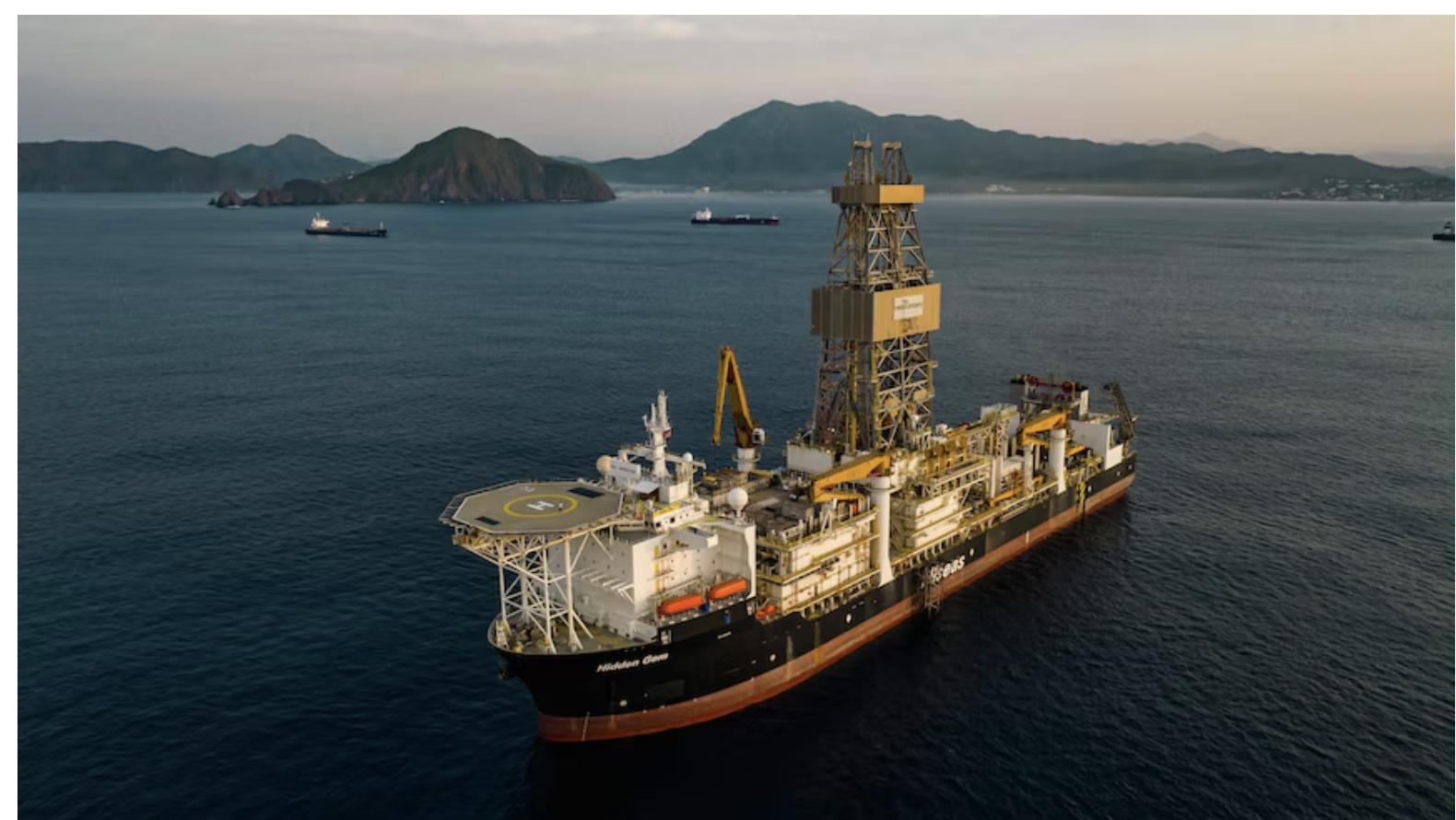
The ocean floor, covering more than 2/3 of the planet, remains one of the least explored regions on Earth, yet it is rapidly becoming the next frontier for resource extraction. Governments and corporations are now racing to access vast deposits of critical minerals like cobalt, nickel, and manganese, which are essential for batteries, electric vehicles, and renewable energy technologies. But unlike previous resource booms, deep-sea mining is not an established industry; it remains largely theoretical, meaning debates are less about current practice and more about how it should be governed, regulated, and evaluated before it begins.
This creates a fundamental tension at the heart of the issue. The global transition away from fossil fuels will require a dramatic increase in mineral production, yet the ecosystems targeted for extraction are among the most fragile and least understood on the planet. At the same time, the international system meant to govern these resources, the International Seabed Authority, has yet to finalize rules for commercial mining, even as pressure from states and corporations accelerates.
As a result, deep-sea mining sits at the intersection of climate urgency, scientific uncertainty, and unresolved global governance. The question is no longer just whether these resources exist, but whether exploiting them is necessary, or whether it risks becoming a preventable environmental mistake in the name of decarbonization.
What is Deep Sea Mining
Deep-sea mining refers to the extraction of mineral resources from the ocean floor, typically at depths ranging from 400 meters to more than 6,500 meters below the surface, far beyond the reach of sunlight. Industrial-scale machinery is used to collect mineral deposits from the seabed, often by scraping, cutting, or vacuuming the ocean floor.
The primary targets of deep-sea mining are three types of deposits. The first, and most commercially promising, are polymetallic nodules: potato-sized rocks scattered across the seabed that contain high concentrations of manganese, nickel, cobalt, and copper. The second are cobalt-rich crusts, which form on seamounts and contain valuable metals used in electronics and energy storage. The third are seafloor massive sulfides, found near hydrothermal vents, which are rich in copper, zinc, and other critical minerals.
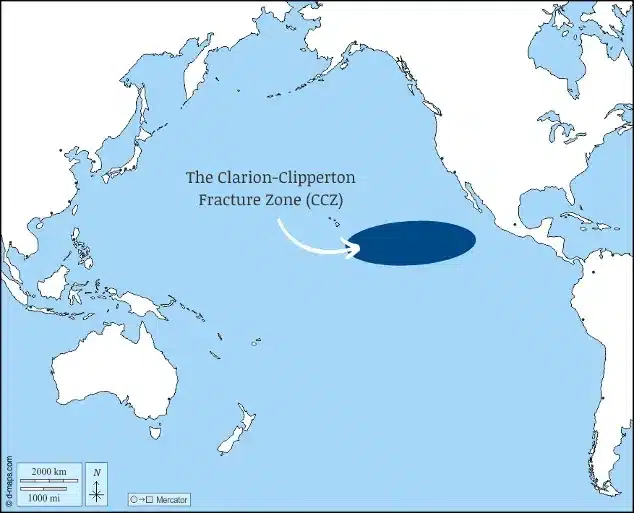
Most exploration efforts have focused on the Clarion-Clipperton Zone, a vast region of the Pacific Ocean between Hawaii and Mexico where polymetallic nodules are abundant. However, attention is also expanding to new frontiers, including parts of the Arctic seabed, raising additional environmental and geopolitical concerns.
Global Governance Battle: ISA & Economic Concerns
At the center of the deep-sea mining debate is a largely unknown but increasingly powerful institution: the International Seabed Authority (ISA). Created under the United Nations Convention on the Law of the Sea (UNCLOS), the ISA is tasked with governing mineral resources in “the Area,” the parts of the ocean floor beyond national jurisdiction, which are legally designated as the “common heritage of mankind.” In principle, this framework is meant to ensure that the benefits of deep-sea mining are shared globally, particularly with developing countries.
In theory, the ISA is responsible for ensuring that revenues are distributed equitably. However, this mandate is complicated by a fundamental problem: the absence of finalized regulations governing commercial extraction. Some states, including resource-seeking and industrialized countries, are pushing to accelerate mining in order to secure access to critical minerals. Others, including many Pacific Island nations and European states, are calling for a moratorium or precautionary pause until the environmental and economic risks are better understood.
This conflict is driven by incomplete regulation. While the ISA has already issued more than 30 exploration contracts to governments and private companies, it has yet to finalize the rules that would govern full-scale commercial extraction. This gap has created a regulatory gray zone, where development is advancing ahead of oversight, raising concerns about how benefits will be distributed..
These tensions intensified in 2021 when Nauru, a small Pacific Island state sponsoring a mining company, invoked the so-called “two-year rule,” a legal provision that forces the ISA to finalize mining regulations within a set timeframe. Although that deadline has passed without a finalized code, it has significantly increased pressure on the ISA to act, accelerating negotiations before scientific consensus or political agreement has been reached. In effect, deep-sea mining is not waiting for regulation—it is driving it.
Current projections suggest that the financial returns from deep-sea mining could be relatively limited and highly concentrated, with the majority of profits flowing to private companies and a small number of sponsoring states. For many developing countries, especially those not directly involved in mining operations, the expected economic benefits may be minimal, raising concerns about whether the system will meaningfully deliver on its promise of shared global wealth.
At the same time, the environmental and economic risks are likely to fall disproportionately on vulnerable regions. Many of the areas targeted for mining, particularly in the Pacific, are closely tied to the livelihoods of coastal and island communities that depend on marine ecosystems for food security, employment, and cultural identity. Disruptions to fisheries or ocean health could therefore have immediate and long-term consequences for populations that may see little of the financial upside.
For many Pacific Island communities, opposition to deep-sea mining is not only environmental or economic, but cultural. The ocean is central to identity, food systems, and sovereignty, making seabed extraction a direct threat to both livelihoods and ways of life. As a result, these states have emerged as some of the most influential voices calling for a moratorium, positioning themselves at the center of global negotiations despite their limited economic power.
These dynamics have led critics to draw parallels between deep-sea mining and earlier forms of extractive industry, where resource wealth is generated in one region but captured elsewhere. In this framing, deep-sea mining risks reproducing familiar patterns of inequality, where the Global South absorbs environmental harm while the Global North captures economic gains.
Even within the private sector, there are signs of uncertainty about the industry’s economic viability. Some major companies have pledged not to use minerals sourced from the deep sea, citing environmental concerns and reputational risks. Meanwhile, analysts have pointed to the high costs, regulatory uncertainty, and speculative nature of the industry as potential barriers to profitability. While companies like The Metals Company are actively pushing to commercialize deep-sea mining, major downstream buyers—including BMW, Google, and Samsung—have pledged not to use deep-sea minerals.
Together, these dynamics raise questions about whether deep-sea mining can be justified as a fair or sustainable development strategy.
For Deep-Sea Mining
Proponents of deep-sea mining argue that it is a necessary and even inevitable step in the global transition to clean energy. Technologies central to decarbonization, including electric vehicles, wind turbines, and large-scale battery storage, depend heavily on critical minerals such as cobalt, nickel, copper, and manganese. As demand for these materials accelerates, many policymakers and industry leaders warn that existing land-based supplies may be insufficient to meet future needs.
From this perspective, the deep ocean represents a vast and largely untapped resource base. Polymetallic nodules alone are estimated to contain significant concentrations of key minerals, often in higher grades than those found in terrestrial mines. For supporters, this presents an opportunity to dramatically expand global supply and reduce potential bottlenecks in the energy transition.
Deep-sea mining is also increasingly framed as a geopolitical strategy. Supply chains for critical minerals are currently highly concentrated, with China dominating the processing and refining of many essential materials. As a result, countries such as the United States, Japan, and members of the European Union are seeking greater resource independence, and view the ocean floor as a way to reduce reliance on politically sensitive or unstable supply chains.
Some advocates further argue that deep-sea mining could offer environmental advantages over traditional mining. Because it does not require deforestation, large-scale land displacement, or the relocation of human communities, it is often presented as a less socially and environmentally disruptive alternative. In this framing, extracting minerals from the ocean floor could avoid many of the well-documented harms associated with terrestrial mining, particularly in regions where governance is weak or environmental protections are limited.
Taken together, these arguments position deep-sea mining not as a speculative industry, but as a strategic solution, one that addresses climate goals, economic demand, and geopolitical vulnerability at once. However, each of these claims remains contested, particularly when weighed against the environmental and scientific uncertainties that define the deep ocean.
Environmental Risks
Despite its promise, deep-sea mining carries significant and potentially irreversible environmental risks. The deep ocean is one of the least understood ecosystems on Earth, yet it is also one of the most fragile. Many species that inhabit the seabed grow and reproduce at extremely slow rates, meaning that any disturbance could take decades, or even centuries, to recover, if recovery is possible at all.
One of the primary concerns is the sheer scale of potential damage. Mining operations could disturb vast areas of the ocean floor, with some estimates suggesting impacts across millions of square kilometers. Unlike localized terrestrial mining, the effects of deep-sea extraction are not confined to a single site. The process generates sediment plumes (clouds of fine particles released into the water column) that can travel long distances, smothering marine life and disrupting ecosystems far beyond the immediate mining zone.
These disturbances extend beyond physical habitat destruction. The deep sea plays a critical role in global carbon cycling, acting as a long-term carbon sink. Disrupting these sediments could release stored carbon back into the ocean and atmosphere, potentially undermining the very climate goals that deep-sea mining is intended to support. In this sense, the industry risks creating a paradox: extracting minerals for clean energy technologies while simultaneously contributing to environmental degradation.
Compounding these risks is a profound level of scientific uncertainty. More than 80 percent of the ocean floor remains unmapped and unexplored, leaving major gaps in our understanding of deep-sea biodiversity and ecosystem function. Scientists are still working to identify species, map habitats, and understand ecological relationships in areas already targeted for mining. Moving forward with large-scale industrial activity in such an environment raises fundamental questions about precaution and responsibility.
Ultimately, deep-sea mining would not simply exploit a known resource; it would industrialize an ecosystem that humanity has barely begun to understand. For many scientists and environmental groups, this uncertainty is not a minor obstacle, but a central argument against proceeding at all.
Do we even need deep-sea mining?
At the center of the deep-sea mining debate is a critical question that is often framed as inevitable but remains deeply contested: is this industry actually necessary for the clean energy transition? While proponents argue that demand for critical minerals will require new sources of supply, a growing body of research suggests that this demand is not fixed, and that alternative pathways could significantly reduce or even eliminate the need for seabed extraction.
Technological innovation alone could substantially lower mineral demand. Advances in battery chemistry, for example, are already reducing reliance on materials like cobalt and nickel, with some newer designs eliminating these inputs entirely. At the same time, improvements in efficiency and material substitution could reduce overall demand by roughly 30 percent, challenging the assumption that supply must continually expand.
Equally important is the role of a circular economy. Recycling and reusing existing materials (particularly from electronic waste and retired batteries) offers a significant opportunity to meet future mineral needs without opening new extraction frontiers. Estimates suggest that circular strategies could reduce demand by more than 18 percent, while also lowering environmental impact and energy use compared to primary mining. In this context, deep-sea mining appears less like a necessity and more like a policy choice.
Critics argue that focusing on alternatives (such as strengthening recycling systems, improving standards in land-based mining, and reducing consumption) would address many of the same supply concerns with far fewer risks. Rather than industrializing one of the planet’s least understood ecosystems, these approaches prioritize using existing resources more efficiently and responsibly.
Framing deep-sea mining as inevitable obscures the reality that it is one option among many. The decision to pursue it reflects political and economic priorities, not a lack of alternatives. As a result, the debate is not simply about whether the technology is feasible, but about which path the global community chooses to take in balancing climate goals, environmental protection, and resource use.
Future of Deep Sea Mining
The future of deep-sea mining will be decided in the coming years, as the ISA faces pressure to finalize rules for an industry that does not yet fully exist. Some states and corporations are pushing for rapid commercialization, while others, including Pacific Island nations, environmental groups, and major companies, are calling for a moratorium until the risks are better understood. A likely outcome is a middle path: limited approvals paired with ongoing experimentation and evolving regulation.
At stake is more than just a new resource industry. Deep-sea mining sits at the intersection of climate ambition, geopolitical competition, and environmental uncertainty. Driven by demand for critical minerals and supply chain independence, it also threatens ecosystems that are fragile, slow to recover, and still largely unexplored.
This moment matters because decisions are being made before large-scale mining even begins. It’s not about regulating an industry—it’s about deciding if it should exist at all. The real question isn’t whether we can mine the deep sea, but whether we should before we understand it.
Bibliography
Ashford, O., Baines, J., Barbanell, M., & Wang, K. (2025). What We Know About Deep-Sea Mining — and What We Don’t. World Resources Institute. https://www.wri.org/insights/deep-sea-mining-explained
Borodyna, O. (2026, January 27). Critical minerals geopolitics in 2026: risks, supply chains and global power shifts. ODI: Think Change. https://odi.org/en/insights/critical-minerals-geopolitics-in-2026-risks-supply-chains-and-global-power-shifts/
Deep Sea Conservation Coalition. (2023, October). Deep-sea mining: the ecosystems at risk and potential impacts. https://deep-sea-conservation.org/wp-content/uploads/2024/02/DSCC_FactSheet2_DSM_science_4pp_OCT_23.pdf.pdf
EJF Staff. (2025, January 4). The Metals Company’s latest deep-sea mining gamble signals financial…. Environmental Justice Foundation. https://ejfoundation.org/news-media/the-metals-companys-latest-deep-sea-mining-gamble-signals-financial-failure-press-release
Feichtner, I., & Ginzky, H. (2024). The struggle at the International Seabed Authority over deep sea mineral resources. Npj Ocean Sustainability, 3(1). https://doi.org/10.1038/s44183-024-00098-y
Fox, M. (2026, January 24). Deep Sea Mining, Explained. Earthjustice. https://earthjustice.org/article/deep-sea-mining-explained
IRENA. (2023). Geopolitics of the Energy Transition: Critical Materials. Www.irena.org. https://www.irena.org/Digital-Report/Geopolitics-of-the-Energy-Transition-Critical-Materials
Myers, J. (2025, September 12). What are the pros and cons of deep-sea mining? World Economic Forum. https://www.weforum.org/stories/2025/09/deep-sea-mining-critical-minerals/
Prasad, S., & Hardy, E. (2023). Why Pacific Island States Are Concerned About Deep-Sea Mining. Carnegie Endowment for International Peace. https://carnegieendowment.org/posts/2023/11/why-pacific-island-states-are-concerned-about-deep-sea-mining
Ramirez, R. (2026, March 27). The controversy over deep-sea mining, explained. Yale Climate Connections. https://yaleclimateconnections.org/2026/03/the-controversy-over-deep-sea-mining-explained/
Reid, H. (2021, June 29). Pacific island of Nauru sets two-year deadline for U.N. deep-sea mining rules. Reuters. https://www.reuters.com/business/environment/pacific-island-nauru-sets-two-year-deadline-deep-sea-mining-rules-2021-06-29/
Shukman, D. (2021, April 3). Companies back moratorium on deep sea mining. BBC News. https://www.bbc.com/news/science-environment-56607700
Simas, M., Aponte, F., & Wiebe, K. (2022). The Future is Circular Circular Economy and Critical Minerals for the Green Transition Authors. https://wwfint.awsassets.panda.org/downloads/the_future_is_circular___sintefmineralsfinalreport_nov_2022__1__1.pdf
The Metals Company’s Deep-Sea Mining Bet Hinges On Permits. (n.d.). Finimize. https://finimize.com/content/tmc-asset-snapshot
The Pacific Ocean’s seabed could soon be open for deep-sea mining — here’s what that means. (2023, July 7). ABC Pacific. https://www.abc.net.au/pacific/isa-prepares-to-resume-deep-sea-mining-negotiations/102559238
UN Scientific Advisory Board. (n.d.). DEEP-SEA MINING WHAT IS DEEP-SEA MINING? WHY IT MATTERS? https://isa.org.jm/wp-content/uploads/2025/10/250403-DSM-Brief-Rev-7.pdf
Vajiram Editor. (2024, July 24). Clarion-Clipperton Zone. User’s Blog; vajiramandravi. https://vajiramandravi.com/current-affairs/clarion-clipperton-zone/
Vedda, V. (2025, June 16). Critical minerals at the center of geopolitical tensions. Dws.com. https://www.dws.com/en-us/insights/cio-view/macro/critical-minerals-at-the-center-of-geopolitical-tensions/
WWF. (2021, December 1). Business Backlash Against Deep-Sea Mining Grows. WWF. https://wwf.panda.org/wwf_news/?4541466/Business-Backlash-Against-Deep-Sea-Mining-Grows
WWF. (2024, August 6). Deep sea mining - WWF Arctic. WWF Arctic. https://www.arcticwwf.org/threats/deep-sea-mining/


.svg)