

November 2025 marked 30 years since the signing of the Dayton Peace Agreement, ending the three-and-a-half-year-long Bosnian War. Amidst the breakup of the former Yugoslavia in 1991, an independence referendum was held in Bosnia and Herzegovina (BiH) in February 1992 to decide whether the country would declare independence, and an overwhelming majority voted “Yes”. This upset Bosnian Serb leaders, who boycotted the vote, but independence was declared in March 1992. Following this decision, Bosnian Serb forces took over the capital, Sarajevo, and the country was officially subject to war from 1992 to 1995. By the end of the war, it is estimated that there were roughly 350,000 casualties, including over 97,000 deaths. The war was marked by war crimes and the Srebrenica genocide, which was ruled a genocide by the International Criminal Tribunal for the former Yugoslavia following the killing of over 7,000 Bosnian Muslim men and boys by Bosnian Serb forces. The conflict is now widely considered by the international community to be an “ethnic cleansing” of Bosniak and Croatian civilians by Bosnian Serb forces. The war officially ended on November 21, 1995, with the signing of the Dayton Peace Accords, which was orchestrated by representatives from the United States and the European Union, and officially signed by Alija Izetbegović (BiH), Slobodan Milošević (Serbia), and Franjo Tuđman (Croatia).
Although not considered perfect by Bosnians and international scholars, the Dayton Accords were created to bridge ethnic divides, establish a new political framework, and be a temporary solution with an immediate goal of stopping the war. Annex IV of the agreement lays out a temporary constitution that splits BiH into two Entities: the Federation of Bosnia and Herzegovina and the Republika Srpska. Additionally, the constitution establishes that there will be three presidents: one Bosniak and one Croat for the Federation and one Serb for the Republika Srpska. These three presidents must work together to govern the country, with one High Representative appointed by the United Nations Security Council above them all to settle disputes and ensure compliance with the Dayton Peace Agreement. Due to the complexity of the Dayton Accords and the lack of political will by the three parties, there has been no replacement constitution or legal framework for Bosnia and Herzegovina, which has resulted in an often complicated and crippled political system in the country due to consistent disagreements between the three presidents. As BiH pursues full European Union membership, the constitutional framework established by Dayton has continually been undermined by political figures in BiH, stalling the country’s path to the EU.
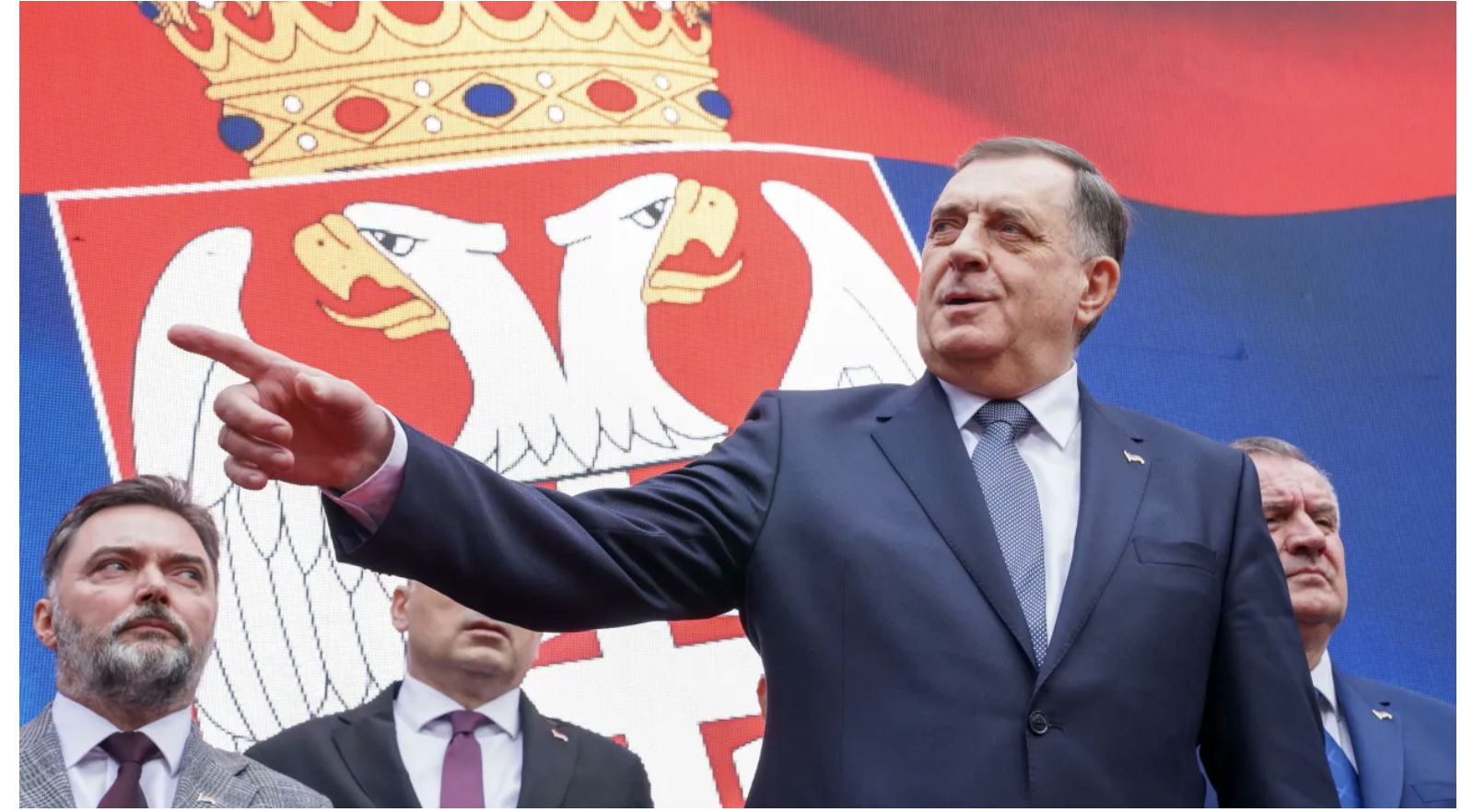
At the center of the political disarray is the former President of Republika Srpska, Milorad Dodik. Dodik has a long history of spewing separatist rhetoric that has persisted for the past several years. In 2021, Dodik publicly stated that Republika Srpska would withdraw from Bosnia’s armed forces in an attempt to separate the entity from the rest of the country. Following the 2022 Russian invasion of Ukraine, Dodik continued to call for Republika Srpska to separate from BiH and unify with Serbia, along with visits to Russian President Vladimir Putin, signaling his alliance with Russia. In May 2024, the United Nations adopted a resolution to declare July 11 as the “International Day of Reflection and Remembrance of the 1995 Srebrenica Genocide.” Following this adoption, Republika Srpska and Serbia outwardly opposed the recognition, as Dodik and Serbian authorities do not recognize that a genocide was committed in Srebrenica. Most recently, he passed laws that made it illegal for national law enforcement or judicial officials to operate in Republika Srpska, seemingly making it impossible for Dodik to be held accountable for any violations of the Dayton Peace Agreement.
On February 26, 2025, the Court of Bosnia and Herzegovina sentenced Milorad Dodik to one year in prison and a six-year ban from holding public office for his calls to separate from the Federation of BiH and join Serbia, directly violating the Dayton Peace Agreement. The legal pressure on Dodik intensified on March 27, 2025, when Bosnian authorities issued an arrest warrant against the Republika Srpska president. The move followed his defiance of High Representative Christian Schmidt, who recently annulled two laws passed by the Republika Srpska National Assembly that undermined the integrity of the Dayton agreement and public institutions in BiH. Following the issuance of the arrest warrant, Dodik only escalated his separatist rhetoric by refusing to recognize the legitimacy of the Bosnian court that sentenced him. In response to Dodik’s sentencing, the Republika Srpska government established a separate High Judicial and Prosecutorial Council through the Republika Srpska National Assembly. In an attempt to dismantle state institutions, this step allowed Dodik to declare various state-level laws and institutions as unconstitutional, and therefore taking power away from the central legal powers in BiH.
The U.S. Department of State also took actions to condemn the Republika Srpska for undermining the Dayton Peace Agreement, facilitated by the United States and President Clinton in 1995. Specifically, the United States placed sanctions on five individuals close to Dodik to place pressure on Republika Srpska to abide by the peace agreement and avoid any potential future conflict. As of August 2025, Dodik was officially removed from his position as the President of Republika Srpska following Bosnia’s Central Electoral Commission's upholding of his one-year prison sentence and six-year ban from all political activities. Under Bosnian law, any elected official sentenced to more than six months in prison is automatically forced out of office. However, it is unlikely that Dodik will serve any time in prison, given Republika Srpska’s extensive support from neighboring Serbia.
On November 23, 2025, a snap election was held to decide the next president of Republika Srpska. Dodik-backed candidate Siniša Karan of the Alliance of Independent Social Democrats won 50.89% of the vote and will serve the rest of Dodik’s term, until general elections are held in October 2026. Karan was one of the key players under Dodik who helped orchestrate the Republika Srpska secession plan and has supported Dodik’s past decisions to separate from the rest of the country. Further, Karan has been identified by the Working Group for the Implementation of the Conclusions of the Commission for Srebrenica as participating in the 1995 genocide, an event in which the Republika Srpska government has been accused of denying. Karan has vowed to continue Dodik’s policies as he begins his term, a major setback for those hoping that the president-elect would distance themselves from the former president’s separatist rhetoric. Even with Dodik’s removal from office, Karan’s election and alliance with the former president raise concerns that Dodik is still in control behind the scenes.
Citizens of BiH have expressed fears of what political instability means for the future of the country. Memories of the war are still fresh in the minds of Bosnians, and the fear that another conflict could break out frequently plagues the minds of young people and those old enough to remember the dark period of the war. The rise in separatist rhetoric from Republika Srpska highlights the gaps in the Dayton Peace Agreement and reaffirms its original status as a temporary solution. Bosnia and Herzegovina must now find a long-term solution, particularly as the country is seeking to move out of its candidate status and become a permanent member of the European Union.
References
Al Jazeera. (2025, August 6). Separatist Bosnian Serb leader Dodik sacked from office by Bosnia officials. https://www.aljazeera.com/news/2025/8/6/separatist-bosnian-serb-leader-dodik-sacked-from-office-by-bosnia-officials
Al Jazeera. (2025, November 22). Bosnia’s Republika Srpska votes for Dodik’s successor: What to expect. https://www.aljazeera.com/news/2025/11/22/bosnias-republika-srpska-votes-for-dodiks-successor-what-to-expect
Al Jazeera. (2025, November 23). Barred Bosnian Serb leader Dodik’s party wins presidential election. https://www.aljazeera.com/news/2025/11/23/barred-bosnian-serb-leader-dodiks-party-wins-presidential-election
Associated Press. (2025, July 10). Appeals court in Bosnia confirms sentence for Bosnian Serb President Milorad Dodik after stoking separatist tensions. PBS NewsHour. https://www.pbs.org/newshour/world/appeals-court-in-bosnia-confirms-sentence-for-bosnian-serb-president-milorad-dodik-after-stoking-separatist-tensions
Association for Diplomatic Studies and Training. (2014, November). Negotiating the Dayton Peace Accords. https://adst.org/2014/11/the-dayton-peace-accords/
Balkan Insight. (2025, November 20). Dayton’s decades: The temporary deal that still defines Bosnia. https://balkaninsight.com/2025/11/20/daytons-decades-the-temporary-deal-that-still-defines-bosnia/btj/
Center for Justice and Accountability. (n.d.). Bosnia. https://cja.org/where-we-work/bosnia/
Curtis, J. (2025, May 22). Bosnia and Herzegovina: Political situation and regional challenges (Briefing Paper No. CBP-10013). House of Commons Library. https://commonslibrary.parliament.uk/research-briefings/cbp-10013/
European Western Balkans. (2025, February 26). The Court of Bosnia and Herzegovina convicts Dodik; he declares that BiH no longer exists. https://europeanwesternbalkans.com/2025/02/26/the-court-of-bosnia-and-herzegovina-convicts-dodik-he-declares-that-bih-no-longer-exists/
Hronesova, J. (2015, December 14). A flawed recipe for how to end a war and build a state: 20 years since the Dayton Agreement. LSE European Politics and Policy (EUROPP) Blog. https://blogs.lse.ac.uk/europpblog/2015/12/14/a-flawed-recipe-for-how-to-end-a-war-and-build-a-state-20-years-since-the-dayton-agreement/
Hronesova, J. (2025, April 2). Milorad Dodik’s separatism finally catches up with him. LSE European Politics and Policy (EUROPP) Blog. https://blogs.lse.ac.uk/europpblog/2025/04/02/milorad-dodiks-separatism-finally-catches-up-with-him/
Latal, S. (2025, March 10). Dodik’s assault on Bosnia’s justice system can only lead to chaos. Balkan Insight. https://balkaninsight.com/2025/03/10/dodiks-assault-on-bosnias-justice-system-can-only-lead-to-chaos/
Mujkić, A. (2013, April 29). Why Bosnia is still not a democracy. Al Jazeera. https://www.aljazeera.com/opinions/2013/4/29/why-bosnia-is-still-not-a-democracy
Organization for Security and Co-operation in Europe. (1995, December 14). The General Framework Agreement for Peace in Bosnia and Herzegovina. https://bih.osce.org/bih/126173
Remembering Srebrenica. (2021, June 24). The Bosnian War – a brief overview. https://srebrenica.org.uk/what-happened/history/bosnian-war-a-brief-overview
Reuters. (2025, March 27). Bosnia court issues international arrest warrant for Serb leader Dodik. U.S. News & World Report. https://www.usnews.com/news/world/articles/2025-03-27/bosnia-court-issues-international-arrest-warrant-for-serb-leader-dodik
Sarajevo Times. (2025, August 15). Who is Sinisa Karan, the newly elected president of RS? https://sarajevotimes.com/who-is-sinisa-karan-the-newly-elected-president-of-rs/
Szpala, M. (2025, July 25). Bosnia and Herzegovina’s European integration impasse. Centre for Eastern Studies (OSW). https://www.osw.waw.pl/en/publikacje/analyses/2025-07-25/bosnia-and-herzegovinas-european-integration-impasse
U.S. Department of State. (2025, January). Sanctioning anti-Dayton actors and their financial enablers in Bosnia and Herzegovina [Press release]. https://2021-2025.state.gov/office-of-the-spokesperson/releases/2025/01/sanctioning-anti-dayton-actors-and-their-financial-enablers-in-bosnia-and-herzegovina/
United States Holocaust Memorial Museum. (2013, July). Bosnia and Herzegovina, 1992–1995. https://www.ushmm.org/genocide-prevention/countries/bosnia-herzegovina/1992-1995
Wintour, P. (2025, May 28). Renegade Dodik leaves Bosnia in limbo. The Guardian. https://www.theguardian.com/world/2025/may/28/renegade-dodik-leaves-bosnia-in-limbo


.svg)